
The Short-Long Vs. Long-Short Glide? What Are They...and Does it Really Even Matter?
When it comes to glide shot putting, many people forget how different technique can be from country to country, coach to coach, and individual to individual. There are many subtle nuances that contribute to a successful glider.
There are these two types of glide styles people talk about. The short-long (which will be abbreviated to S-L) and the long-short style (abbreviated to L-S). There is information and resources on the internet from coaches and athletes that try to categorize each and demonstrate which one is best. However, putting these styles in two different boxes can be restricting and unnecessary. There are also many misconceptions to each.
I had the idea for this unique article back in March 2025. Throws University did their recap of recent throwing performances on their Throws Show on YouTube with Jason Coon and Sam Weeks. They reacted to my 2nd place performance of 20.46M at the NCAA Championships. Both had some kind words to say about me and my technique that I appreciated.
What I found interesting was how they described my throw. Coon said "[I] hit that short-long glide" with a "wide base" and a "big punch." If I had to categorize my technique it would be the long-short technique over the short-long technique 10 times out of 10. However, I do not typically get caught up in the labels of the two styles. Instead, I believe similar to the rotation, there are many different styles and ways to hit the key positions and apply force necessary to make the ball go far. I watch all types of gliders and take different things from each. Everyone is trying to accomplish similar things, just how they end up there is different. If I could be seen as a short-long glider, does that mean the specific stereotypes of the technique are applied to me as well? It is interesting how perception depends on the person. Let's explore more.
What are the Differences?

This is a chart I found online from Scott Cappos (former throws coach most recently at Nebraska). He broke down the differences between the two techniques. Notice how many of the word choices are absolute. One's left arm in the L-S "must be pointed in the opposite direction," yet the S-L it is "allowed to open." The L-S and S-L right foot placement in the middle is described as being sucked under versus variable. In the L-S, the right foot must be turned toward 90 degrees, but the S-L it is variable between 100-140 degrees. Also, notice how the L-S right foot action is "turn then lift," while the S-L is "lift then turn."
The idea is that in the S-L style, you can have a large double support phase by being in a larger power position. Your base is wider. This makes sense. You glide less overall distance, however you will be able to apply force over a longer path in the delivery than the L-S if done correctly. When you think of S-L gliders, who do we think of? I think of the East Germans; Ulf Timmermann, Udo Beyer, Sven Oliver Buder, as well other athletes like Tomasz Majewski, David Storl, and Ladislav Prasil. On the other hand, the stereotypical L-S would be applied to Al Feuerbach (who is the poster boy of it), Michael Carter, John Brenner, and Mike Stulce. Personally, I think it is less of a short-long versus long-short style and more so a European versus American style. More of this will be explored later.
Let's see what other coaches have to say about the different styles.
Dane Miller at Throws University
He first describes the long-short components: "Because the [long short] glider has to drive LONGER across the circle, the non-dominant leg or the left leg will get slightly higher. This higher left leg will enable the right foot to have more time to cross the circle BUT it can also lead to a delayed double support position."
He continues by saying: "The left foot will be above the left knee, which is not something we would see with the short-long position. This means that the long-short glider will be a bit more explosive and a bit “jumpier.” Typically, long-short gliders like Manuel Martinez will be extremely strong, extremely explosive and extremely violent on the finish. Long-short gliders are the classic gliders that are ABSURDLY strong, very explosive and very aggressive."
He also discusses the short-long style: "Short-long gliders will have a bit more of a dynamic start in the back of the circle. Think about Valerie Adams or Ulf Timmerman dropping their hips out of the back of the circle, they start tall and drop aggressively to a flat foot as they drive across the circle. The left foot on short-long gliders will almost hover just above the concrete and the right foot will not come off the ground until the absolute last possible second! This happens because the right foot will not travel as far in comparison to the long-short gliders."
He argues that "the short-long movement is going to be more advantageous for gliders. It forces the glider to be very patient and this leads to a ton of speed through the middle of the circle. The short-long glider has a longer period to develop force in the double support position." While, "the long-short glider is the type of athlete that is ABSURDLY strong and powerful. These are the athletes cleaning well over 200k, bench pressing close to 270k! They are very successful with a SHORTER period of force development that is extremely violent and aggressive."
Citation: Throwsuniversity, Are There Really TWO Types of Glides?!?!, Throwsuniversity.com, 15 November 2020, https://www.throwsuniversity.com/post/are-there-really-two-types-of-glides
John Smith, throws coach at the University of Mississippi
"In my opinion the Fuerbach technique requires more strength and great natural athletic ability. Lets not forget that Al was also a National champion in Olympic style lifting, he had fantastic strength for his size. His strength to weight ratio was on of the best of all-time. What makes the Fuerbach technique so difficult is getting an athlete to pull his right leg under at 9.00 O'clock position, then to start rotating it before the upperbody and ball slides ahead of the right leg. The other problem is the stopping the ball movement in the center of the ring to give the right leg time to rotate ahead of the upper body. Both these problems will cause very poor results. This technique requires a very long double support phase which requires great self generated explosive power out of the right side of the body."
Smith continues with "The main goal should be to keep the ball in constant motion with no breaks. This is where Al's technique can become frustrating to athlete and coach. I also disagree with the simultaneous landing of both feet in the Fuerbach technique. It's much easier to fire the right side as the left leg makes a right -left rhythm landing. The natural body reaction to the left foot landing is the right side turning and lifting."
Citation: Thompson, Glenn, "John focuses on shot put," Longandstrong.com, http://www.longandstrong.com/Interviews/jjsshot.html
Coach Mohamad Saatara, coach at the University of Texas
At a throws camp at Hartnell College in 2019, Coach Mohamad Saatara broke down some of the nuances of the glide. He mentioned how Feuerbach's narrow base and position was something natural for him. "He was a champion of weightlifting and his feet were naturally turned in." But, people said "that is the perfect technique and tried to copy it." Saatara explains how when you glide you need your right leg "to come under you." For taller athletes as he demonstrates in the video, that base may be wider than someone shorter. "Your base should fit your size" and the "shot should still be outside your [right] leg."
Citation: "Cal Berkeley Throws coach Mohamad Saatara talks about the shot put glide," YouTube, Uploaded by Frankie Martinez Throws, 16 January 2019, https://www.youtube.com/watch?v=XaLFXBZl5SI
What Should We Teach? Let's break it down.
The Base and the Right Foot Positioning
I think there is a misconception about the short-long glide. There is an over-exaggeration about the perceived benefit of the wider base of the power position. People discuss how Al Feuerbach was the epitome of the long-short glide. A very narrow base. Right foot turned first. Active reverse. Makes sense. However, if you watch any videos or photos of Feuerbach, he almost never hits passed the middle of the circle. He was around 6 feet tall. That is actually a fairly big base compared to his size. Timmermann, Storl, and Majewski never get to the middle of the circle. However, they are 6'4, 6'5, and 6'9, respectively. If Feuerbach was 2 to 3 inches taller would he keep the same base length? I can not know for sure, but probably not.
This ties into Saatara's point. Find a base that is comfortable for you. I would not teach a high school athlete to be in a super wide power position base typically. To say the short-long will give you an advantage of a longer double support phase (which Smith actually attributes to the long-short) and therefore one should do it is misleading.
First, is their foot underneath them? For me, I shoot for the middle or slightly past. I'm 6'3. I find if I don't get at least to the middle, then the shot is not as far over the right leg as it could be, while still feeling natural to explode out of. If the right foot isn't under enough, it is hard to keep the ball way over the right leg to create torque. Instead, it shifts with the center of mass and makes it very hard to stay back. In addition, too big of a base may present the idea of a longer delivery path, but if your right foot comes off the ground too soon because the base is too big...does this maximize the ground contact that is supposed to be an advantage? No, it does not.
There are advanced levels to all techniques. Timmermann extended his left foot very low and got it down very quick, while other German athletes like Udo Beyer and Ralf Bartels shot it high and there was more of a delay like Smith mentions. The delay of the left leg is most notably a short-long style and not a long-short one, which Miller attributes the other way around.
The foot positioning is quite interesting. The chart above describes the L-S positioning as 9:00 versus the S-L variable between 100-140 degrees. The latter is difficult. Some argue that the Feuerbach positioning is harder for athletes because it feels unnatural. I agree with the fact that people's bodies are built differently and some positions are harder for others. I will argue that in theory the Feuerbach position should not only be easier but is more advantageous for athletes. Why? if you are pre-turning your right foot it not only creates an automatic stretch between the lower and upper body, but also reduces the amount you must turn your hips to attack the throw. I've experimented with the 11:00 position before. It not only made it very hard to turn and use my hips in the throw, but it also reduced the automatic stretch I gained by pre-turning. This conflicts with Smith's anecdotal training with his wife Connie who threw 19.58 gliding.
Some may argue how the S-L isn't about turning but lifting first. Many athletes do this, is it generating more torque? I don't know if it is. As stated before, many of the European athletes, both rotational and glide, turn their knee and less emphasis on their foot. This does not mean they are not thinking of turning and utilizing their hips. Take Storl for example, his right foot does not turn the way Feuerbach, Carter, or mine do. But, I had him recently analyze a throw of mine and he discussed how you must think of the foot leading the throw. I don't think he does this as well as he discussed, however he is trying to do this. He did not mention anything about lifting the shot first or lifting at all actually. His priority is still to turn his hips first before the ball shifts. Christian Sperling, the national coach for junior athletes in Germany for shot put told me that there is a bit of a debate about if the foot must turn. He believes it does.
The issue with lifting the hips is that it can lead to early extension of the legs, which can stop the foot, knee, and hip from properly rotating. In the rotation, this style may be effective for some, where the rotational momentum from the entry can still allow the hip to rotate naturally even while thinking lift. In the glide, this can be less forgiving.
Another example would be John Brenner. If you watch his feet in the middle, his right foot does not turn that well. His hips and knee turn well, while the foot is more like Storl. When interviewed, Brenner said his focus was on the foot to turn but he had trouble doing so. He used Feuerbach as a model early on and then mostly Timmermann. In the boxes of so-called short-long and long-short, these two would be in opposite ones. In my interview with Feuerbach, he discussed the European style and S-L versus L-S. it was not a focus for him and he used the words "too mechanical" when breaking the styles down.
I know Brenner and his coach Art Venegas worked a more double pivot style finish. So, maybe that changed how the right foot turned or maybe it was truly just an inability to do so. Why is this important? If we did not hear from the primary sources, one could assume they are not trying to use their right foot and knee to turn to lead the throw. The aftermath from not knowing leads to assumptions. Then, it is taught that you do not need to. It could be taught that you do not want to turn and drive the hips first in the glide, but lift and go up...just look at Storl and Brenner coaches could say. Maybe some have already. But, now we are getting more answers from the sources themselves.
Photo Comparisons:
Base and Right Foot Positioning.


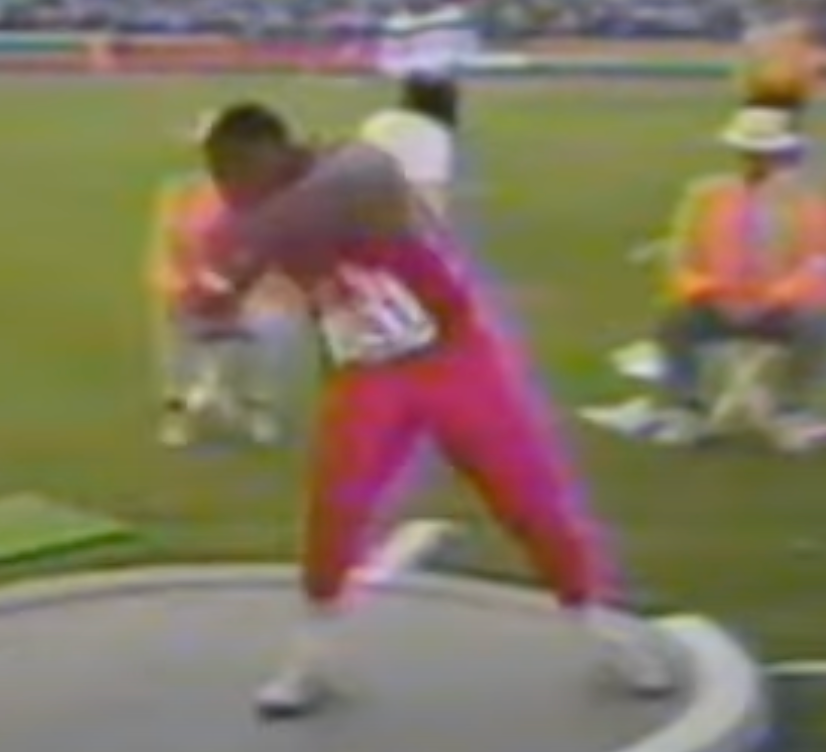
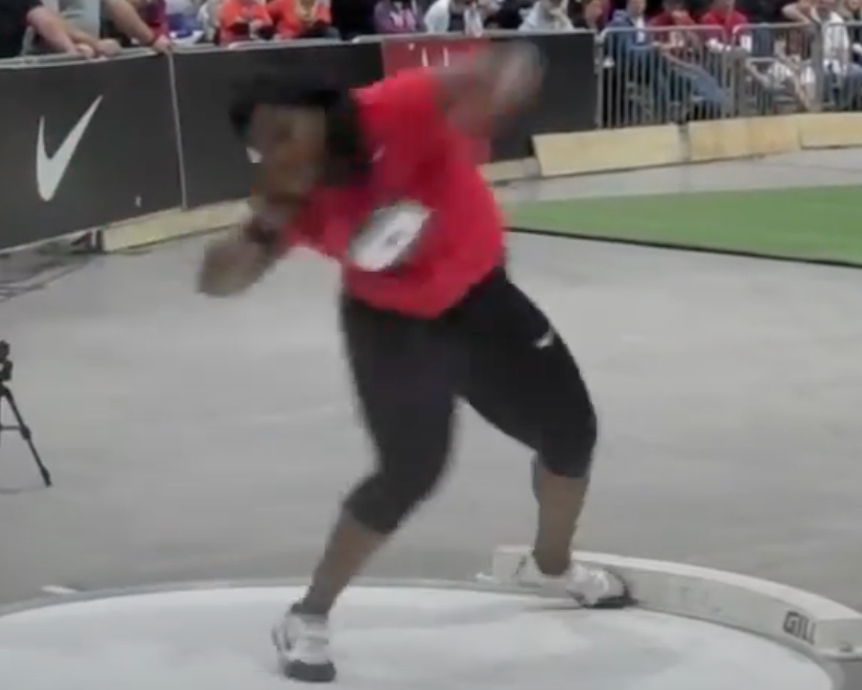

Michelle Carter 5'9 in a base bigger than her father. Feet pointed at 9:00.
What Does the Power Position Look Like When it is Too Large and What's the Negative?
When the base is too large a few things happen. It is hard to keep the shot over the right leg and the weight back. It is hard to get the right foot, knee, and hip ahead of the upper body because of a weight shift. Smith argues against the simultaneous landing of the right and left leg. In my career, I have had a slight delay in high school, to at the same time grounding in half my college years, back to a slight delay. I think at the same time is very difficult to do. However, I believe it is imperative to try to reduce the delay. Why? It is so much harder to stay back on your right leg if your left foot has an obvious delay.
Timmermann never landed his right and left foot at the same time, but they were quick. This quickness got to double support fast without his weight shifting. You can have a longer delay, but I bet most of those athletes have enormous stands with little conversion benefit to the glide. Look at Alessandro Andrei. He had what I call a "floating left leg" a very apparent delay. He threw 22.91M while doing this. Watch him later in his career out of his prime. He struggled to go passed 20M and his right and left delay was not only more apparent, but so was his premature shift in the delivery. Distance is distance, but if you want to not only maximize the glide in the short-term but also for the long-term and not limit yourself, you must create the largest conversion possible. Simply pushing from your right leg to lift the shot without much torque can make the ball go a distance for very powerful athletes. But, to make it go very far, athleticism coupled with the power to create torque is where it takes off.
I will show a few examples. The point of these articles is to discuss thought-provoking analyses. Knowledge can only grow with distinct and unique opinions. My goal is not to disparage or argue someone' way of technique or beliefs are wrong. I just think there needs to be more discussion about different styles or how to think about the throw. It needs to evolve. I've chosen two examples below to show their lower body and positioning.


Notice the floating left leg similar to Alessandro Andrei. If he got his left foot down faster in Frame 1, then he could keep the shot and his weight back. You can see in Frame 2 how his large base and setup has put his weight more on the groin of his right leg. Frame 3 shows the cause and effects of the prior. This technique has achieved 20+M throws.


Notice his right foot at 11:00 in his large base. From Frame 1 to Frame 2, you can a dramatic shift of weight and nothing happening from the right leg. You need to achieve double support to activate the right side. Frame 3 shows the result of the setup. Notice how his right has not turned and instead presses to throw. It is hard to get separation into the throw. The very tall men can be effective with the 'lifting' idea, but for most the key is the active torque and whip of the hips.
But, Is the Right Foot Versus the Right Knee really a Different Style? Or is it actually a Glide Technique Concept?
I think there are two themes at play here. There truly is a lift first versus turn first style. Some coaches argue for this action of the lower body in the delivery. I have spoken to gliders who think about 'lifting' the shot. For me, I will not use the word 'lift' in my technique. I end up thinking vertically, which stops the rotation in my hips. The feelings of the delivery are very nuanced. There also is a stylistic difference between the rotation of the knee versus foot. This should not be confused with the lift versus turn concept. I believe these are two separate conversations.
When I watch Tomasz Majewski throw and deliver a shot, his finish reminds of Filip Mihaljevic. Two completely different techniques. One glider and one rotational. Both are tall men. You can clearly see how when they land, it is not the whip of the hips they are trying to do. It really is the lifting of the shot up and over the block leg. They seem to both want to increase their length over the toeboard as well. It is similar to a seesaw effect. Their bases are narrow versus wide. But, look at how they use their legs. There is not a lot of rotation. You can even see how Mihaljevic goes from up to out and over his block leg. This is a unique comparison. There is a specific delivery style that some athlete use. There seems to be a lifting of the hips emphasis versus a hip rotation speed delivery. Again, without talking to these men maybe this is not the case, but it sure appears like it. The point is this style is not mutually exclusive to the glide. It is athlete dependent. If we did a rotational spin chart to categorize the styles...it would not be possible! There are too many variations. This is the same with the glide. Let's see what you think.


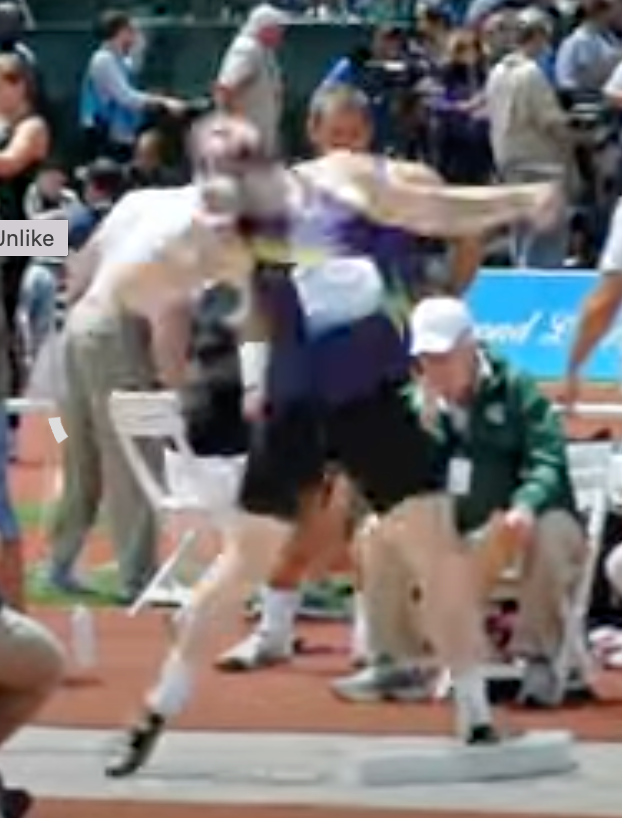


Now, I'll show an example to see the stylistic differences between the knee and foot rotation. It is not glide versus spin or tall thrower versus short. Here is Tomas Stanek versus Ryan Crouser.


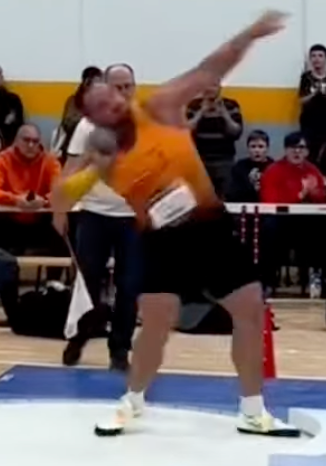


Another point, Smith and Miller both mention how they think the long short style requires more strength. According to Miller, these are athletes that are "cleaning well over 200kg, bench pressing close to 270kg." I am not sure his data about these numbers. Feuerbach's olympic lift numbers were fantastic, as well as his natural jumping and athletic ability. His pound for pound strength levels were not overly exceptional for the times. A 580 lbs squat and a 402 lb bench press. Obviously, he had other gifts (olympic lifting, jumping, athleticism). Other than Manuel Martinez and I'm sure some of the 1970s and 1980s guys, the long short is stereotypically not the technique you need to have the biggest weight numbers. In fact, biomechanically it would be the short long where you would need them if you go off Smith's point.
Smith has previously noted how having a power CNS is the key to big stand throws. He works to conclude that less drug fueled throwing has hurt the glide because it has eliminated these big stand throws from the CNS. However, the short-long position is based off a longer power position. Something that speed is supposed to benefit. However, this is counterintuitive. The short long would benefit from athletes who do in fact have bigger stand throws. Why? Your base is much longer and wider. Meaning you don't get as much speed from the back of the ring and covering ground. So, if this is the case, I would argue that you would need more strength than the long-short going off this argument. However, I do not believe that strength levels are the sole direct correlation to far stand throws. David Storl would be an outlier for his lack of weight room strength yet notoriously far stand throws compared to many others, where Tom Walsh would be for his strength levels and lack of a stand throw. When you think of 200kg cleans and 270kg bench pressing, I think of the East Germans. Add in Alessandro Andrei from Italy as well. The decision to teach a high school athlete to be in a bigger or smaller base should not be due to that conclusion.
The question is why is this worth discussing? Well, from a grassroots level there are athletes looking to throw farther. The internet can provide information on technique in the click of a button. However, it does not mean it's good. I've worked to show how the glide technique and the conversations around it are misleading. We need to do better. My other article "An Investigative Analysis into the Stagnation of the Glide Shot Put," was not written to harp on for the need of the glide. If I cared that much, I would have pushed my younger brother to start with the glide in 8th grade. Instead, I was the proponent for him learning the spin very early on. I know the merits of the glide for the right athlete, but the rotation has shown fine success with an abundance of athletes in all shapes, sizes, and abilities. But, for the athletes still pursuing the glide, there needs to be better coaching and commentary. There is so much untapped potential in it because of the lack of this information. Be a student and make sure to learn why you are doing certain technical things.
Another reason is because I've studied this for many years and drawn my own conclusions. When I started to get better, it was before a lot more information exploded on the internet. I am happy I learned to throw before that occurred. You can gain a lot by studying throwers and dissecting your conclusions by watching hours of their competitions, training, and drills. You become the driver of your technique and understanding.


Comments