
Series Article #1: NJ's Best: Interviews with the 7 New Jersey Natives who have Thrown 20 Meters+ in the Shot Put Since 2011
Updated: Feb 28
The motivation behind this article started early on with the website. I thought it would be unique to have an article section that would cover interviews, stories, and any discussion regarding the throws. I always thought articles from Adam Nelson, Reese Hoffa, Ulf Timmermann, or anything I could find from the outdated throws forums were like gold. Podcasts are convenient, but reading always felt like data. No excess information that was unimportant. Just curated and to the point.
New Jersey has had a rich history in the throws. Just recently from the 2025 USATF National Championships in August, Sam Mattis (East Brunswick High School) made yet another team in the discus, Joshua Awotunde (Delsea Regional High School) wins his first national title in the shot put, and Curtis Thompson (Florence Township Memorial High School) captured his first gold as well. New Jersey is no stranger to track and field greatness. The shot put in particular is second to maybe only Pennsylvania. It is hard to beat a state that has produced Joe Kovacs, Ryan Whiting, Darrell Hill, and Jordan Geist. New Jersey, we have some work to do!
Nonetheless, there have been 7 men since graduating high school in 2011 and after who have thrown 20M+ with the 16lb shot put. Seven men in 15 years. That is quite the statistic. It is important to note that all of these throwers tossed the discus over 180' in high school and all threw both in college to varying degrees. The article will focus on their shot put development. There are interviews with six of those seven men. We hope you enjoy how Nick Vena, Stephen Mozia, Braheme Days Jr. (no interview taken), Joshua Awotunde, Andrew Liskowitz, Jordan West, and CJ Licata (myself) got to be talented shot putters. Any future New Jersey throwers who throw 20M will be interviewed and added as well.
We hope you enjoy.
Nicholas Vena, Morristown High School '11, University of Georgia '15.
12 lb NJ State Record Holder: 75'10.25
US HS Record for Total Throws over 70' with 96 Throws
16 lb Personal Best: 20.68M (67'10.25)
8x Meet of Champions Winner in the Shot Put
7x NCAA-All American
*Date Interview taken: 12/3/24

Q: Nick, can you give a little background about your start in throwing?
NV: I was introduced to track and field back in first grade. My Dad started taking me to track meets. He would bribe me to go to meets by treats from concession stands. I was actually an avid soccer player growing up, and then eventually the commitment became too hard and I focused more on shot put. I started shot putting, actually throwing in 3rd grade. Very basic stuff and nothing too crazy.
Once middle school came, I started toying with different techniques and it kind of just grew from there. If you were to ask me back when I was a young boy would I have had the success that I did…I would have said I wouldn't have even guessed. It was a good journey.
Q: When did you know that you could throw really far?
NV: That’s an interesting one. Going into high school I had no idea. Did I throw far in middle school? Yeah, I was throwing an 8lb and sure it was going out pretty far. But, going into my freshman year of high school, I opened up probably 55 or 54 feet. I thought that was cool. That’s a pretty good throw.
By the Meet of Champions, I threw 66 feet as a freshman breaking the national freshmen record for indoor track and field. I didn't see that coming. I did the grind, kept working, and trusted the process and it just unfolded. By the end of that Spring season, I hit 67 feet and I thought ‘we're moving and grooving now.” Did I think my following year I’d go 70 feet? No, I had no idea. I just put the time in and kept working at it. I trusted the process and the people I was working with.
Q: What led to your high school successes?
NV: I can tell you right now…my upper body was not the reason. I think I came away with my best bench at 295 lbs. For some reason, that lift I don't know if we didn't focus on it or approach it the right way, but it took me until my freshman year of college or that summer to get over 300.
I was pretty fast. I was a big fan of running. I loved running as a kid. I liked sprints. You know my leg development was pretty good. I was somewhat explosive and I think that was kind of a combination of running and everything around that line. I love sports, so I was always active and doing what I needed to do. I worked the technique quite a bit and I trained normally like any other thrower, like three times a week [or] four times a week. I had this level of excellence of myself trying to hit positions, work the technique, [thinking] “this is what I'm looking for, or this is what I want to hit.” When I got to meets it was like “okay it's go time.” I was fortunate in my [high school career] I had competitions nationally, but also in-state competitors that would push me. You can't take anything for granted [because] there's always someone working just as hard as you.
Q: What were your high school, college, and professional progression?
High School:
2008 Freshman Year HS: Shot: 67'2.25, Disc: 164-6
2009 Sophomore Year HS: Shot: 72'8, Disc: 180'11
2010 Junior Year HS: Shot: 72'10.5, Disc: 186'4
2011 Senior Year HS: Shot: 75'10.25, Disc: 186'2
College:
2012 UVA: Shot: 19.51M, Disc: 54.84M
2013 Transferred to UGA: Shot: 19.43M, Disc: 50.07M
2014: Shot: 20.39M, Disc: 51.48M
2015: Shot: 19.99M, Disc: 52.81M
Professional:
2016: 19.82M
2017: 20.42M
2018: 20.68M
2019. 20.60M
2020: 19.91M
Q: Why UVA?
NV: My whole life goal ever since I was in 3rd grade was to be a health and physical education teacher. That was my primary goal in life to find a college that could educate me to [do that]. That was priority number one. Priority number two was it needed to have a throws program that I felt meshed well with my philosophies, how I was as a thrower, and cultivate me further. Virginia at the time was the fit. I had a good career there, it was a real bumpy ride. I finished with 64 feet as a freshman. I’ll take it.
Originally my coach was supposed to be Carrie Lane. She called me a couple days before I went to campus and said she moved positions. Coach [Ross] Richardson [took over] and did not show up to campus until October/November-ish. A lot of changes that year.
Q: After freshman year, you transferred to UGA. What prompted this decision?
NV: When I was coming out of high school, my top three schools [included] Georgia. I knew the reputation Georgia had and they had a health and physical education program. It seemed like the right move at the time. It had SEC competition and I wanted to go and mix it up there. Transferring is not the easiest of moves to make, especially when you go farther away from home. I was 6 hours [at UVA] and now I was 14 hours, which needed a plane ride. It’s not easy, especially as you come in as a sophomore. Georgia did a good job of integrating freshmen and transfers together, but it did not have that same feel. You kind of feel like you miss something in developing [relationships].

Q: What were some big technical changes in college or as a post collegiate that were important in your development?
NV: One thing a lot of people commented to me on in high school was I didn't have a good enough block leg at the front. My right foot was kind of touch and go (It should be noted that Vena is left-handed). Did it destroy my throw? No, I threw 75 feet, I did something good. Could I have been more explosive at the front? Yeah, probably. I didn’t think my high school technique was perfect, but I didn't think it was bad.
College, I had a bit of rough times. Figuring the back of the circle, messing with that. I think there was too much manipulation of my technique, so I got lost of the feelings. My freshman year, I had a good series in the end and my junior year I started [to] figure it out. My senior year, my technique was in weird spots the whole year. Not until NCAAs/regionals, I caught one at 19.80. It wasn't until post-college where my technique got more stable. I was getting some good philosophies. I worked with Abe Flores, the old Monmouth coach and Jon Kalnas, here and there. They got me solidified out of the back of the circle a bit more, so it allowed me to hit better positions in the front and middle.
Q: What was the hardest part about adjusting to the 16?
NV: I don't think I was physically prepared enough to throw coming out of high school. I had a 295 lb bench press and that’s a big difference between someone who has a 400 lb bench press. I was just learning olympic lifts my freshman year of college. I might have toyed around with them a little my senior year of high school. It wasn't big talk when I was in high school. I don't remember too many kids doing cleans and we didn't really see olympic lifts as impactful. I did them more for quickness. I think also with the added bodyweight it messed with my timing. I didn't have the strength pieces, so it changed me up a bit from high school. It created some other issues. I was playing catch up. It wasn't the easiest [transition] looking back.
Q: What things have you had to overcome in your throwing career?
NV: I’ve had many coaching changes over my career. I worked with Coach [Tony] Naclerio. I went to his clinics once or twice a week in high school, but all those other days I was basically training myself. College, I went through multiple coaching changes at Virginia. Georgia, not throws coach changes, but coaching changes there. Different philosophies. Post-college, I worked with multiple different coaches. It wasn't because it didn't work out, it’s just things outside coaches’ and my hands that played a factor. I worked with Coach Flores, who ended up getting very sick. Then, I worked with Kalnas. Then, I worked with multiple people. It was never a consistent, steady road. A couple injuries here and there, but everyone gets those.
Q: What made Nick Vena throw far?
NV: Just keep working at it. You can't get down on the bad days. The amount of bad practices I had…there were more bad practices than good. The frustrating days, it’s not ignoring those days, but persevering through those days and keeping the eye on the prize. Yesterday’s practice doesn't impact the next day’s practice. You have to move forward and identify things. Some days, one thing may not be working that day. Could be because you're tired, or you had to study for a huge final, or a tough workout the next day. It doesn't mean the practice is a loss, but how can we find the positives from it.
Q: What were your weaknesses?
NV: Strength is one. I think a little bit if you look at my throws in college, I didn't really get out after it at the toeboard. I felt like I left some at the table in some meets. It was a little technical breakdown and what not. I competed hard, just my technique did not allow me to hit it. My finish was always a little rough and I think it was because I rushed the back of the circle.
Q: What was a typical training week for you? # Throwing sessions, lifting, etc.
NV: I think it depended as I got older. I think when I was younger I could throw more days in a row. As you get older with the 16 lb shot, you can only take so much haha. I definitely at least would get 3 days a week, if I could get a 4th, sure. It all depended on how the body felt.
During my post-collegiate career, I was working full-time as a teacher. I had to work 7 hours a day. I always made sure I lifted normal things. My lifting schemes had changed so much over the years, so I can’t give you an exact number on that.
Q: What were your strength levels?
Bench: 460 lbs. toward the end of my post-collegiate career
Squat (hatfield style): 650 lbs
Front squat: 500 lbs
Clean: 365 lbs junior year of college
Snatch: 250 lbs
Deadlift: 630 lbs
Q: What makes a high-level throwing athlete?
NV: Physically, a good thrower needs to be athletic and to move their feet efficiently and quickly. Throwing is a quick event. You need to be able to be reactive in a short amount of time, but also athletic. Strength does play into it, but I also think there is a point where you can be too strong for the event…or I could be wrong. You have to be patient, I think that’s the key to throwing far. Too many throwers get too antsy with positioning or just trying to crush the ball. There is a process that needs to unfold. I think patience is a huge attribute.
Q: Did you throw different shot weights?
NV: I did throw different weight shots. I threw both ends of the spectrum. I threw heavy and I threw light. I never went lighter than a 6k. I think they both have their positives and negatives, it just depends on how you use them, how many reps, and what part of the season. I threw the 20 lb at one point, I don’t recommend 20 lb with a full turn. That hurts a lot. Not a great experience. Can people do it and have done it? Sure, but me personally I would rather use that for more specific strength like stands and what not. There’s pros and cons. I think you can feel positions that way. Light balls…more moving and grooving.
Q: Did you train partial throws? (i.e. stands, halves? If so, how far?)
NV: My stand throws stunk and were not great. If you looked at my distance with my stand throw versus my full turn it did not translate. Half turns, I did those more post-high school. In high school, I was horrible with them. I couldn’t figure them out. I got very frustrated, but was like “I’m not worried about this.” College, did them here and there. Still wasn’t great at them, but it was all about the full turn for me. South Africans I did them, but they were even worse than my half turns haha. I was mostly just a full turn guy and navigating that technique. If I remember correctly, I think I had a stand throw around 48’ one meet. I just used it as a warmup and did not care about how far it went.
Q: Who were your technical models?
NV: I’ve had a lot of technical models over the years. I watched many different throwers; Reese Hoffa, Randy Barnes, Adam Nelson, Christian Cantwell, John Godina, Andy Bloom, you name it I’ve watched them. Each thrower offers a great characteristic.
Q: Most overrated thing about throwing training?
NV: I think a lot of people say with training “you have to sit around and hang around all day [at training],” it makes things a little stale. I always found that I need to be active and can’t just sit around waiting for the next practice. I think that was a part of me as a thrower.
Q: After UGA, you trained post-collegiately back in NJ. How was that experience? Working? Coach?
NV: It’s not an easy task figuring out how to throw post-collegiately when you’re not tied to a university. You basically throw at high schools and can only throw there when A. they don’t have a function and B. are done with school. It is not easy to navigate in that sense. I was up in Morristown [working] at the middle school teaching and I used to drive down to the Shore to go throw with Coach Flores, which is probably about 90 minutes give or take. Those were long days. Then, entering meets without being associated with a university, not every meet will accept open athletes. I could tell you many times when I was throwing medballs at a paddle ball court or driving to facilities.
Q: You were extremely fast, especially for your size 6’5 and weighing up to 315 lbs +. How did you maintain speed and be as lean as you were?
NV: I can’t say I loved being that weight. People told me that was the way to go. Looking back on it, I don’t think I felt the greatest. I don’t think my body could handle the weight. However, at 315 lbs, I believe I ran a 5 second 40. I box jumped probably 44 inches. I thought running was integral. I felt good as a thrower when I ran and thought it was very beneficial to my training.
Q: One sentence to describe your competition mentality and energy. (i.e. aggressive? calm?)
NV: I’m focused. I don't let anything get in my way. I have a mission and I’m going to go for it as hard as I can. The ‘killer mentality’ some people would say I had that, but it was more focus and drive. Those were the right words to describe me.
Q: What motivated you to wake up every day and throw far?
NV: I enjoyed it. I did it in 2nd and 3rd grades, so almost 20 years. It was part of my life and a hobby. I liked competing. I liked mixing it up. Training was part of it.
Q: What do you do now?
NV: I am a health and physical education teacher and am on my 9th year. I coach high school track and field and am the assistant coach for the Winter season and head coach for the Spring season at Morristown high school. I do the weight room in the Fall and volunteer with the cross country team. I work with throwers outside school here and there that are interested as well. Very busy life!
Q: Was the transition to a life without throwing hard?
NV: At first it was. This was 20 years of doing this and now it’s just done. It comes a time when you can’t throw forever. Do I still mess around when I’m at practice with the kids throwing something…yes. For example, today I was coaching high jump and even jumped today. I have the fond memories and am fortunate to have had a good career. It has shaped how I am as a coach today.
Q: What is your fondest high school and college track and field memory?
NV: I enjoyed my first Meet of Champions win a lot when I was a freshman throwing at Toms River in the bubble. That was a good one (Nick threw 66 feet for a freshman national record and his first MOC title). Also, when I doubled as a sophomore in the shot put and discus, and won the Penn Relays that year with 72 feet. Also, the 75-10.25 throw [my senior year] was pretty cool.
I liked ACC Championships my freshman year. I won the discus that year with huge PR and the shot with a PR and won the outstanding freshman of the meet award. Another moment was when I got 3rd at NCAAs with 20.16. Those were pretty fun moments. Post-collegiately, I had a really good indoor season in 2018 and got 5th at Indoor USAs. I threw 20.68 that year.
Q: Looking back on your career, how has the strong tradition of NJ throwing influenced you or given you a sense of pride?
NV: New Jersey has grown some tremendous athletes over the years. Not just in the shot, but overall. I think New Jersey and their coaches are a testament of developing the athletes in a positive direction. My father used to read off the older throwers about their stats and performances. Now, I am talking about it with myself.
Bonus: Any advice for younger throwers looking to improve?
NV: Just work at it. Things aren’t going to be figured out in one year, two years, three years, four years, or five years. If that was the case, Michael Carter’s record would be 90 feet and the world record with the 16 lb would be 80 feet. It is not a quick process, but a long, developing one. That is for all events in track. Be along for the ride.
Stephen Mozia, Hackensack High School '11, Cornell University '15
12 lb Personal Best: 63-8.25
16 lb Personal Best: 21.76 (71'4.75)
Ivy League Indoor Record Holder
NCAA Indoor and Outdoor Championships Runner-Up
2016 Rio Olympian Competing for Nigeria
*Date Interview Taken: 11/6/24

Q: Stephen, can you give a little background about your start in throwing?
SM: I grew up in Hackensack, NJ. I didn't start throwing until I was in high school. I did a lot of basketball as a little kid. When I went to high school, the three main sports people played were football, basketball, and then everyone used to say “if you play football you have to do track.” So, I did track, but many people know this about me…that I was the most uncoordinated human being ever. I think my shoe size grew from 10 to 13 in one year in 8th grade. My parents did not like me that year haha. This made me trip over myself in basketball and football practice. I also wasn’t that fast, so I was a pretty slow kid as well. Everyone told me “to join the track team and get faster.” I started running and that wasn't going very well for me, but [I thought] I may not be that good at this, but I’ll get faster so it’ll be worth it. One of my best friends at that time said “hey, I’m a thrower, it’s great. You can get a lot stronger and you play tight end anyway in football, so you can lift everyday if you come throw.” I started throwing and by the end of freshman year, I broke like 100 feet in discus. At the time, I thought it was impressive. I was awful in the shot put. I think it was maybe 31 feet. That was pretty much how I started.
My sophomore year is really when I figured out my mojo. It started because this guy named Vaughn Crenshaw, who I think was around a 160 foot thrower a few years before me, walked up to me when I was practicing my freshman year and asked “if I knew what to do with the discus.” I probably threw it at the time 125’, and he just grabbed the discus and threw it 180’. He offered to train me and volunteer his time. That’s probably how I became a good discus thrower. I think I got up to 40 feet my sophomore year in the shot, but then junior year everything took off. I was a late bloomer compared to most of the really good people throwing far since their freshman year.
Q: When did you know that you could throw really far?
SM: I don't think that was ever my personality. One thing people in my town still remember me for is I would walk home and spin. I lived 25 minutes away walking to my house from school and I did that each day. I’d be spinning and making that walk 45 minutes. I just wanted to perfect this thing. When I was younger, I thought perfecting it was a far simpler thing haha. I wanted to win and get to that next level.
I also never really thought about throwing far. I more thought about winning the next meets. We had great competition in New Jersey, and my goal was always the short-term goal of winning leagues, counties, or states. So, my focus on throwing farther was more driven on winning than on just a number.
Q: What was your high school, college, and professional progression?
High School:
2008 Freshman Year: Shot: 32', Disc: 105'
2009 Sophomore Year: Shot: 43'1, Disc: 152'6
2010 Junior Year : Shot: 56'4, Disc: 177'9
2011 Senior Year: Shot: 63'8.25, Disc: 187'11
College:
2012: Shot: 19.10M, Disc: 53.22M
2013: Shot: 19.89M, Disc: 59.91M
2014: Shot: 20.79M, Disc: 62.80M
2015: Shot: 20.18M, Disc: 61.34M
Professional:
2016: Shot: 21.76M, Disc: 62.20M
2017: Shot: 20.83M, Disc: 59.67
2018: Disc: 59.95M
2019: Disc: 57.17M
Q: Why Cornell University and what was the Ivy League experience like as an athlete?
SM: My brother went to Cornell and I always thought I was going to be a Rutgers kid. I knew I wanted to do engineering. My senior year, I was getting letters like most people, but I wasn’t paying too much attention to them. One of the middle meets of the season in NJ during indoor season was an invitational for some good people in the tri-state. I remember Chuk [Chukwuebuka Enekwechi] was there and [a lot] of coaches were there because they had a college meet the next day. That was the day everyone started calling me. I was looking at schools and getting a couple offers, where Arkansas was one of the big ones. My brother [told me] the Cornell track team is extremely cool and I should give Cornell a chance. I wasn't a huge fan of the Ivy League at first, but I decided to give Cornell a visit. I went to campus and loved it. I loved the team, everyone, my coach Megan Johnson, and that my brother went there.
Q: You threw 19.10M indoors as a true freshman. How?:
SM: I would have to say, it's probably two things. My brother that went to Cornell passed away while I was there.
So I think that created a new level of motivation in my life, where I was very much like, “I don't have an infinite amount of years. I got to get everything out of this life.” I think it gave me a new level of focus and drive to really get the most out of all aspects of my life. To this day, it's a huge motivator of mine.
[It’s] never a good thing for things like that to happen, but I definitely turned it into probably a lot of positives in my life.
I would say the second [motivating] thing [was] the captain of the team at that time, Bob Belden. He was a hell of a thrower.
He took me under his wing and I [thought] if I latch myself to Bob, [he] will show me the right way. And I wasn't that strong. He taught me how to lift, I copied a lot of his form. I was pretty weak. My bench press my first year of college was probably 265.
I mean, he was great and I thank him for a lot of my success. And then also, my college coach [Megan Johnson] gave me flexibility. [Many] people just want to say, “this is how you should throw, and we're just going to make you throw like that.” If she had forced me into a standard form, I wouldn’t of thrown as far at such a young age. As I got older, my form became more normal. I think she allowed me to play around with my form and try some weird things which allowed me to really use the power from my legs, core, and my general explosiveness.
I think that between having a good model in Bob to know what is right, mixed with having a coach that's flexible enough to try things was the combination. I would also say Cornell. If you've been an Ivy League, the energy is just competitive in that environment, [where] everyone is just striving for their best self. That pushed me to [high] levels. I do think just being in the Ivy League just forces the best out of you.
Q: What was the hardest part about adjusting to the 16?
SM: The 16 lb is heavy as heck. But, the first year, I actually liked the 16 for one reason. It just allowed me to get more wrap. I felt like the 12 didn't hold me back as well as the 16 was able to. I was really a person that believed in separation. So, I thought…even more separation! I just need to be able to explode through it. It probably worked out for both the shot and disc. The heavier implements allowed me to use my strengths more and allowed me to feel where the implement was more. The biggest transition was I needed to get stronger. I didn't have great form in high school. I think if you have great form in high school and then you go to the 16, now it’s just using the [same] form with a heavier implement. Versus, I was a blank slate, and a ball of explosiveness, so let’s [now] figure out how to have [good technique].
Q: What things have you had to overcome in your throwing career?
SM: I got all the injuries just like everyone. I just see those as added stories to a character arc. I always remember this one time my sophomore year where I hurt my back. It was hurting so bad that it was hard to walk. I still had to go to engineering class because I had a quiz and then [after] to the athletic trainer. I didn’t have a cane, so I just used my umbrella. I was walking around campus with the umbrella just like an old man to get to class. Then, I basically crawled to the athletic trainer, [where] they were like “you could have probably just called us and we could have come over [to get you] haha. So, the classic injuries, knee injuries, back injuries, wrist injuries, all the good stuff. You rehab and it’s fine.
Q: What made Stephen Mozia throw far?
SM: Going back to my senior year, I did not throw quote on quote “well.” I think I got up to about 20.70, but I didn’t throw as well as in my junior year. I got out of a relationship and was finishing engineering school. So, senior year was just a bad year. I think being able to train [post-collegiately] with Coach John Newell and Tavis Bailey was the perfect situation. I can work this job, train, and get back to my old self.
In the macro, my discipline and grit. I am a person that can do one really hard thing every single day for 365 days without much complaint or concern. I didn’t realize this as much when I was throwing. People ebb and flow in how hard they train. I’m really good at pushing [myself] at a consistent level. I might not have the super amazing day like someone, but I will never have the worst day. I’m doing one inch of improvement every single day, even when it’s going bad. Keep going forward one step.
I would say from a physical standpoint, I have long levers and I’m relatively explosive. That combined with my training mentality probably got me to where I was.
Q: What was a typical training week for you in college versus at UTK?
SM: I was a three event thrower in college versus only shot put post-collegiately. I think that’s one difference. At Cornell, I probably threw more because I was throwing [the hammer, discus, and shot put]. I would throw shot put Monday and Thursday, then discus Tuesday and Friday, and hammer [one or two days]. It was probably 5 to 6 days of throwing during the offseason. Lifting was four days a week and conditioning one day a week. Sunday was completely off. My coach liked one on one coaching sessions, or two athletes. We’d throw for an hour and a half and we’d all lift together.
Post-collegiately, I had a job. I worked from 8 to 5 and would drive after work to the University of Tennessee to train with Newell. That was me probably throwing 3 days a week. Monday, Wednesday, and Friday. I’d have lifts on Tuesday, Thursday, and Saturday, and take Sunday off. I’d do pretty big conditioning on Saturday as well, with one more day of conditioning after throwing during the week. With Newell, it was always plyometrics or medball stuff. In college, it was a lot of sprinting.
Q: What were your strength levels?
Squat: 605 for 6 reps during my junior year of college.
Bench press: 515 for one post-collegiately
Snatch: 295 for one
Power cleans ( just high pulls): in the 400s
Jumps: somewhere in the high 30s. Close to 40.
Q: What makes a high-level throwing athlete?
SM: The best people I know, all of them are technicians. I can talk to another high level thrower and they just get it. It’s the ability to almost engineer your body and the level of detail [to manipulate] it. It combines body awareness and your mind. The way you get ‘feel’ is by throwing a ton of times and thinking about every little move.
Q: Did you throw different shot weights?
SM: I think stand throws with the 18lb in college. But, Newell was a bigger person into different weighted shots. I can’t think of any PBs. I just knew I threw a lot of different weighted shots with [him].
Q: Did you train partial throws? (i.e. stands, halves? If so, how far?)
SM: I did a good chunk of non-reverses with Newell because that was the part of my throw, the finish. I don’t want to say I was a non-reverse expert like some people, but I got pretty good. Stands, I warmed up with [them], especially my junior year, I was big on perfecting the stand with the 18lb and really just building up that specific strength. Coach Megan Johnson was really big on specific strength. With the 16, I could probably stand 16M [or] like mid-50s. Half-turn, probably 20 meters. I also did a lot of half turns in college.
Q: Who were your technical models?
SM: I would say everyone. I was a huge person on just watching film and just trying to understand how [people] threw far, because I was like, everyone has something that maybe I could plug in. So, maybe that was it. I used them to try and figure out “how is this person throwing far? What about their throw is getting a pop on the ball? That allowed me to then ask that about myself, “Oh, well maybe I can try that.”
I watched all the classic videos [too]. During my time, it was Reese Hoffa, Adam Nelson, and guys like that. But, I even watched competitors’ film. So, I think I just watched a good chunk of film honestly.
Q: You trained at UTK after Cornell under Coach Newell and 2016 Rio discus Olympian Tavis Bailey- how did you land there?
SM: I moved to Tennessee primarily for my job. I got a job out of college working for a company called Emerson and their division was in Knoxville. But, part of that decision was that I knew I wanted to train. I knew Coach Newell because he used to be at Michigan State and a previous relationship I was in, was in Michigan State, so I would visit my girlfriend at that time. I would just train with Newell [when I visited] and Antonio James. I did that like 2 or 3 times.
So, when I moved to Tennessee, I asked Newell if I could train there and he said [yes]. I just knew him luckily. It is funny how life just works out that way. Also, [another] coach at Tennessee [who went to] Penn State knew me because we competed against each other in college. I just think I was lucky that all the people from my past just happened to be in Tennessee. And I knew Tavis Bailey from of course the throwing circuit. It just kind of worked out.
I thought [post-collegiate training] was easier than college. Compared to engineering school it was no problem haha. The biggest issue is probably just trying to figure out meets and meet schedules.
Working compared to mechanical engineering was far easier. I would say I preferred it. I would say as I got older, a lot of the reason I retired, after a couple years I had to move to Austin, Texas, it got really difficult because [where I trained] was starting to lock down [from Covid]. I have no place to train or go to the gym. The reality is for most people, they don’t just have a lucky setup like I did at Tennessee. Most of the time it feels like I did during Covid. Like how am I going to train? I don’t know how I’m going to get these reps in.

Q: What were some big technical things for you that made the ball go far from college to Pro?
SM: Yeah, I mean, I think getting just bigger and stronger, like 40 pounds of muscle and strength, and actually being able to bench weight was all beneficial. I think that was huge. Learning the non-reverse was a big piece of me being able to actually hit the ball correctly. Another year of wisdom [helped]. I think also I loved Tavis [Bailey] as a trainer partner, so that was good stuff. It was a combination of all that, but between the weight room and the non-reverse learning I think that added a lot of value.
Q: Most overrated thing about throwing training?
SM: I think that lifting does two things. It builds confidence in yourself. If you show the progression of lifting numbers, then you feel “I’m getting stronger.” But, I also think that there’s a baseline strength that you need to throw balls certain distances.
By baseline, I’m talking that you probably need to bench 400 and have squatted 500 at some time to throw 21 meters. After that, I think while getting strong will help, I think the biggest thing that strength helps you do is gain confidence. I think sometimes people focus too much on strength numbers and should focus more on overall getting better. This part of my circle is getting smoother, I’m getting more wrap, I’m learning how to hit the ball, I’m gaining consistency, all that stuff matters just as much.
Q: From watching videos of you, you have an extremely fast and almost wild throw. How did this lead to big throws or cause any issue?
SM: That’s interesting. It probably all came from Vaughn in the beginning because [his] whole thing is “just get low and explode into the end.” That was probably where the initial train of thought came in. Like I said, for most of my life my bench was super weak, but I was always able to squat a good chunk. [trying to] use as much leg power as possible is probably where that came from. There were things that caused problems because of this. No one would ever, including myself, would look at me in the front of the circle say “that’s what the model front of the circle should be.” it caused a lot of unnecessary fouls or not the best finishing form from all the power I generated.
But, I think at the same time, going back to my coach in college, if she were to try making me a traditional, say “hit these positions and stay on the ground,” I wouldn’t have thrown far. I would have thrown so much less. This goes back into letting me do some weird things and try to just maximize my explosiveness through the ball. I think Newell reigned me in a bit [and] [I] learned how to put as much force into the ball.
Q: Tell us about your dual citizenship and your choice to represent Nigeria?
SM: I was a dual citizen and went back to Nigeria a good chunk as a kid. My freshman year of college was pretty funny. I didn’t really know about international competition. What I mean by that is still even [after] throwing 19 meters as a freshman, [I thought] that all this international stuff is so far away from me and for people like [Ryan] Crouser and [Nick] Vena. I’m just staying in my own lane.
But, my freshman year of college, I was a broke college student haha. There was a job right before regionals, where one of my teammates at the time made a company called Storage Squad, which was a bunch of college guys just [moving] boxes and stuff. You just made a ton of money because you were moving people out of their dorm. So, I did this right before regionals and I was exhausted. And I didn’t make it.
My head coach found out and was furious. He was like “are you an idiot? Why would you think it’s okay to just move boxes the week before going to regionals?” I was like, I made a good chunk of money… Then, just because of that [he] [said] you’re going to the U20 USA Championships. He was very passionate about me going. He said “it’s a lighter ball, so at least you don’t have to throw the 16.” I was like “fine, I’ll do this if you want me to, but I don’t want to.” I really didn’t want to go to Junior USAs. I really wanted to have a Summer and hang out with my friends. Then, I went to Juniors and won. And then they were like “you’re going to Barcelona.” I don’t have money haha. [Then they told me] the U.S. pays for everything and I was like “okay, cool…I’ll take that!”
*This prompted later discussion about using his dual citizenship*
I think a lot of competing for Nigeria was I think one, I saw Nigeria, just being candid, an opportunity to gain tons more international experience. Like African Championships, Commonwealth Games, this would be so much more enjoyable. I want to travel the world, like I’ve been to 35 countries already in my life. This will let me go to new places and Nigeria. I could see my cousins and stuff. From a selfish standpoint, I thought this would be awesome for my life. And also, I have always been proud to be Nigerian as well.
So, I reached out to someone I knew who competed for the team and they introduced me to [the process] and I had to wait two years to transfer [my citizenship] over. So, that would make my junior year my first time I could compete for [Nigeria], and I qualified for Indoor Worlds. That started my Nigerian competing journey.
Q: What was the 2016 Olympic experience at Rio like?
SM: The most exciting [realization was] was throwing 21 meters for the first time months before during indoors to think “oh, wow, I can be an Olympian.” I think just like most things, it’s relatively anticlimactic. Don’t get me wrong, the Olympics was one of the best experiences of my life. It’s just one of those things where people go “you’re an Olympian!” But, I think what that means is all those things like the challenges and adversity and all that stuff that I was able to figure it out and get there. I think competing there felt like another meet. I didn’t compete the best at the Olympics. But, I am glad and appreciate that I had that opportunity. But, it also just felt like another track meet today.
Q: What motivated you to wake up every day and throw far?
SM: My wife probably hates this about me haha. I don’t really need motivation. I think it was more just discipline. I don’t think I need motivation to do this every single day. If you have motivation it’s just gravy, but either way, when you’re motivated to do something or not, you still have to do it. I could do a really hard thing that I don’t want to do every single day for extended period of times. If someone told me “you need me to do something for two years that I’m going to hate, but I’m going to be better on the other side?” Cool. Two years, no problem.
Q: What do you do now?
SM: I still live in Austin, Texas. I lead a team of consultants for a cybersecurity consulting company. I have 10 to 15 people that report to me and we secure manufacturing sites. So, everything from an oil refinery to a factory that makes toys or Cheetos. I’ll basically use my team and we’ll do activities to guide companies on how to not get hacked so it doesn’t shut down their factory. I really love it because it’s a constant episode of “how things are made” because in order to secure environments you need to understand what’s actually happening.
Q: Was the transition to a life without throwing hard?
SM: It can be hard. Every person who retires feels like they have more in the tank. However, I look how far everyone is throwing now and I think it’s the best decision I made haha. I know for myself [there was a point] I needed to make money in order to survive. And I’m not making a lot of money in track. I think that I knew if I wanted to be at the level my competitors’ were competing at, I can’t do it halftime. I knew what Joe [Kovacs}, Ryan [Crouser], and Josh Awotunde were doing. That dedication, sacrifice, and all that good stuff is not something you can do part time. I’m not going to beat Ryan Crouser having a full time job. It makes more sense for me to give it up. There are still moments where I wish I was still doing it. But, I think what gives me solace is just [that] I could have quit my job, devoted my life to throwing, and thrown 74 feet one time and had a very good career and never done well at an international competition and it would have been worse than where I am right now haha.
Some people have a real passion for throwing. What I mean by that is they [want] to [go] throw until they're 45. Throwing is their hobby more than anything. I loved competing. I just wanted to win. Throwing is my vehicle for how I’m going to win. I want this ball to go far so I can win meets and throw farther than I did before. I might be able to catch one 22 meter throw or something along that, but in order to consistently get better I would have had to quit my job and devote my life to that. I wasn’t willing to sacrifice that.
Q: What is your fondest high school and college track and field memory?
SM: I was like 200 lbs. in high school. I looked like a lanky sprinter more than anything. I remember this one meet that I was at, people were looking for me, “oh, this kid Stephen Mozia, he throws 170’.” They were looking around thinking I was 6’7 or 6’8. Meanwhile, I was 6’1, lanky, skinny dude. Then, they called Stephen Mozia and people were like “that’s him?” I don’t look like a 170’ discus thrower haha.
[Another} was probably my junior year. We won the state Group Championships meet in New Jersey. It was a funny win. We won Sectionals as a team but we never won the State Group meet. I got first in the group meet in the shot put and got second or third in the discus. Another guy, Conroy Walker, won a couple things. We got on the bus [after] the meet and were like “alright, nice meet, a few of us are going to the Meet of Champions.” Someone called [our] coach and he [said] “where are you guys?...you guys won [the meet]!” We just never thought we were competing for it haha.
In college, my junior year throwing my PB at [The Ivy League Heptagonal Championships Meet]. I will always remember that I had this monkey on my back that I won outdoor Heps every year, but I lost indoor Heps two years in a row, first to [Harvard]’s Ben Glauser, and second [time] to [Harvard’s] Dustin Brode. Both PR’d their throws to be able to take the championship. So, junior year it was looking like I was going to win. There’s a video somewhere on the internet where [Harvard’s then Coach] Andrew Dubs was talking to Dustin and was like “see Stephen’s going to choke again and you got it.” Trying to pump him up to throw farther. And I love Dubs. [But], I heard him. And there was just a switch that flipped in my mind at that moment. I pr’d three times in a row from that moment. If you look at the [series] it’s just funny. And every throw in the finals I just looked at Dustin and [Dubs] haha. They probably don’t [even] remember this.
Q: Looking back on your career, how has the strong tradition of NJ throwing influenced you or given you a sense of pride?
SM: New Jersey could hold our own way against any state individually. New Jersey throwing was always special to me because no matter where you’re from [in New Jersey], you’re just another Jersey guy. New Jersey’s just special. You see how many people it produces year in and year out. I always tell people [that ] if you want to find a good athlete, just go to NJ’s Meet of Champs. I can always be confident that there will be another Jersey thrower that can dominate the NCAA and professional [circuit]. Everyone has unique experiences, but there are also special experiences such as going to sectionals and groups at the bubble [at Tom’s River].
Bonus: Any advice for younger throwers looking to improve?
SM: Kind of what I said about having discipline rather than motivation. Having that mentality in everything, but throwing especially because if you get more reps than your competitor, or squat a little heavier, over a long period of time you will win and get better. I’ve seen very good throwers have great days, but terrible seasons where they just don’t train hard or are demotivated. That will kill you. The person who does it every single day regardless of how they feel are going to be the person that is going to eat your lunch over time. That compounds on each other. Just consistently doing this every single day is going to get you so much further.
Braheme Days Jr., Bridgeton High School '13, UCLA
12 lb Personal Best: 70'8
16 lb Personal Best: 20.21M (66'3.75)

Unfortunately, I could not reach Braheme Days Jr. for an interview. I thought I would include a short snippet of his career.
Days Jr, was a standout high school recruit. He was the #1 recruit in the class of 2013 and boasted PBs of 70'8 and 199'6. A 3x MOC winner, Braheme was a force in the NJ throwing world and even cracked the 65' barrier when he was only a sophomore.

He was a 2x All-American at UCLA. His best finish was 5th at the 2016 Outdoor NCAA Championships. Days Jr. also previously held the American Junior Record with 21.16M with the 6kg shot in 2014. A very energetic and explosive thrower, you can find his monstrous performances and yells on YouTube to witness his 70 foot New Balance Nationals Indoor win or many others like 20M at the Triton Invite, while competing for UCLA.
If anyone knows how I can interview Braheme that would be great. Many athletes have looked up to him, including our next interviewee, Joshua Awotunde.
Joshua Awotunde, Delsea Regional High School '13, University of South Carolina '18
12 lb Personal Best: 61'6
16 lb Personal Best: 22.47M (73'8.5)
SEC Indoor Conference Record Holder: 21.33M (69'11.75)
NCAA Outdoor Championships Runner-Up 2018
2022, 2023, and 2025 World Team Member for Team USA
Bronze Medalist at the 2022 World Championships in Eugene, Oregon
Outdoor USATF Champion 2025
Top 20 Shot Put Mark All Time
*Date Interview Taken: 8/12/25

Q: Can you give a little background about your start in throwing?
JA: Throwing in a way is related to football for me. I started playing football in 5th grade. I [didn't] start throwing shot put until indoors my sophomore year and did the glide up until half way through outdoor season. In 8th grade, the varsity coaches at my high school, Delsea High School, were excited for me. They were coming out to my middle school games and were really excited about having me join their program in high school.
From that point on, I built a relationship with them and for a freshman, they definitely talked to me a lot. They coached me pretty hard my first year playing football there. And then, to stay in shape, even in middle school, everybody who did football did track and field. So, it was kind of hand in hand. The varsity football coaches were the track coaches as well, so Delsea’s a different program in terms of we have two throws coaches. The head football coach is the assistant track coach and the head track coach is the assistant football coach. And they’ve been at [Delsea] for 30 years now.
I was a little hesitant to be a thrower because my initial start in track and field was in middle school and I was a 200 meter runner and a high jumper mainly. So I thought going to high school I was going to stick with the sprints and some of the jumps. But, I grew to be 6 foot by my freshman year at least and my arms started to get long. We had been lifting since middle school at Delsea and we were getting strong. Then, the head football coach told me to throw the discus with him in the springtime. He called it like a ‘natural whip’ that I had from day one.
I was out there in sneakers looking at the upperclassmen and they were really good throwers. There were two guys throwing around 160’ and they were both pretty big dudes, 6’3 and 6’5. I think one of them went on to play football at Princeton and the other was another smart kid who went to Johns Hopkins in Maryland. They were offensive linemen on the football team, but they were great role models for me to have as a freshman in high school. I was like, “man, I don’t know if I’ll be able to throw 160’ when I’m a senior.” My freshman year, I ended up throwing 130’. Late my sophomore year, I threw around 168’ and had already caught up to the seniors in my second year of throwing discus. I had to start throwing shot put because I was rotating so well and producing so much power in the ring. I started rotating a little bit in the spring [for shot put]. There was Braheme Days who was up the road, throwing 65’ as a sophomore and that’s really when the rotation took over in Jersey. Now, everybody’s doing it. Vena more up North had everybody rotating, and then down South, it was Braheme who kind of started it.
I ended up throwing [close to] 50’ my sophomore year, but [our] school record was around 61’ and I think 190’ in the discus. But, I thought I was miles away from ever attaining those marks. Junior year, I was still football heavy and I was the quarterback for the football team. I thought football was going to be my thing going forward still at this point, but it didn’t go so well on the football field and the team lost a lot of games. But, track started going well again for me.
Ended up throwing 54’ in the shot and 188’ I think in the discus my junior year. Still, football was kind of my thing. Instead of throwing, I was going to football camps all year, all summer, during my junior year, and was pretty locked in my senior year. Football went great. We went 11-1 and won a sectional final. I kept getting stronger. The summer before football season, I squatted 500 pounds. My bench wasn’t really that heavy, but I know it was 275 lbs for reps. I power cleaned 315 lbs. On the track, discus came around and ended up at 192’ my senior year and I broke my shot put school record, too. I won the Meet of Champions with my [personal best] of 61’.
Q: What was your high school, college, and professional progression?
High School:
2010 Freshman Year HS:
2011 Sophomore Year HS: Shot: 46'9.25, (50' Dual Meet Unrecorded), Disc: 158'1
2012 Junior Year HS: Shot: 52'3.5, Disc: 186'9
2013 Senior Year HS: Shot: 61'6, Disc: 192'5
College:
Redshirt 2014: Shot: 17.52M, Disc: 51.61M
2015: Shot: 18.57M, Disc: 58.31M
2016: Shot: 20.11M, Disc: 56.31M
2017: Shot: 19.96M, Disc: 58.50M
2018: Shot: 21.33M, Disc: 56.46M
Professional:
2019: 21.13M
2020: 20.45M
2021: 22.00M
2022: 22.29M
2023: 22.19M
2024: 21.80M
2025: 22.47M
Q: Why USC and what was the SEC experience like as an athlete?
JA: Track recruiting started to take off the Fall of my senior year. The first coach that really recruited me was Carrie Lane out of Nebraska. I remember she was the only coach that took a house visit. She came to my house in Jersey, hung out with my family and then I was supposed to take a visit to Nebraska. They were my first official visit offer. And I missed my flight. I remember I showed up to the airport maybe 30 minutes before it was going to take off. I was pretty upset after that because I was kind of leaning towards the Big Ten.
I took my official visits to Rutgers, UConn, Eastern Carolina University, Oklahoma, and South Carolina. I wanted to stay on the East Coast pretty much. So, South Carolina and Coach [Mike} Sergent’s story is pretty funny because initially he came to Jersey to recruit Braheme Days, in the Fall of 2012. But, Braheme was getting recruited by everybody. Braheme ended up turning Serg down [when Serg came to visit in New Jersey]. So, Serg being in South Jersey, went to Milesplit and went to see who else he could potentially recruit. So, he ended up coming to Delsea High School. First time meeting him and it was a great conversation, great guy. I ended up setting a visit from that point to go down there in early January after football season. It was an easy transition [when I went there].
The track team wasn’t doing so much on the throws side. There weren't any male shot putters on the roster during my visit. But, there were two Jersey [throwers] [on the team]. Kaleb Zuidema and Josh Suttmeier. They even came to the Meet of Champions my senior year. I knew they were good guys and good people I wanted to be surrounded by. Even though I was the only shot putter, [there] was guidance I was looking for from Serg and [Zuidema] and [Suttmeyer], and even the walk ons were team captains back then. Andrew Seay, he was a hammer thrower, team captain, and a good leader. Always looked out for me.
I really didn’t care who was here because I knew that what I wanted to accomplish here that Serg could get me here. I always wanted to go to the SEC. The SEC Network just dropped [around] 2011. I remember sitting at home watching all the SEC stuff on TV. You just see big letters: IT MEANS MORE. The SEC is the pinnacle of college athletics and for me to get an offer to go down there was great.
Q: What was the hardest part about adjusting to the 16?
JA: Serg definitely took his time. I threw the 14 lb for a good while, especially because of my freshman year I was trying to make the World Junior team. But, when I got to the 16 my redshirt freshman year, I didn’t [even use] any finger or wrist tape because I built up so much strength in my hand from throwing. Just having that time when I first got to school because that redshirt year [allowed me] to develop and get bigger, stronger, and put on some weight. Just taking easy throws, I’m not competing so everything is just easy.
One of the biggest things [that helped] was probably for the first four years of college, Serg and I would harp on me being wide out of the back. You could see an instant change from when I went from high school to college on how patient and wide I was at the start of the throw.
Q: Your 5th year at USC you launch a meter PB of 21.33 at the Indoor SEC meet for the meet record. What was it like throwing that far? What was it like to find that consistency down the road?
JA: The mark at SECs was a gift and a bit of a curse. I didn’t have a lot of those in between marks, the 20.50s, 20.60s, or the 20.70s. So, getting a meter PR is definitely a gift and a curse for anybody. For me, it was great because you know, I cracked 21 meters. The standard back then was 20.50 for the World Championships. So, I was good to go to a World Championship if I qualified. But, the thing was seeing a mark like that is you start chasing that throw. [I’ve] done it before and you feel like you’ve got it all figured out, especially being that young. I kind of forgot what got me to throw that far throughout the rest of that outdoor year. Even two weeks later at [Indoor NCAAs], I’m like, “how did I throw that far?” I probably wasn’t patient enough looking back at it now because that’s the stuff that I do now. You think you got it all figured out, and lo and behold, you just put everything to the side that got you to get there. That’s something that I’ve learned from.
I talked to Serg about it a lot, especially after my performance at USAs, I just threw 22.47M, but we still got to keep harping on the things that I was doing in practice before I threw 22.47M. I can’t forget what I’ve been working on just because I threw a PR.
I wasn’t a big time recruit coming out of high school. I threw 61’ and there was a guy 10 minutes away throwing 70’, who’s had a lot more big throws than me. [21.33] was my first big throw, objectively, just a big throw. It’s tough because I never had a big throw like that with the 12, and I got it with the 16, but I don’t know how to replicate that. It definitely took a lot of time and patience, but I’m glad I did it when I did. That opened doors for me when I graduated. If I didn’t hit that mark who knows if I would have even been still throwing.
Q: You graduate and then you go to Chula Vista OTC. How did you get that opportunity and what was that like?
JA: Yeah, the opportunity came from seeing the guys that were already out there, like Joe Kovacs, Ryan Crouser, Darrell Hill, and John Jones. Art Venegas was coaching right before I got there, and then John Dagata came there and he was coaching. They wanted to grow the program out there. I think it was a TPP meeting that I took out there. It was a meeting that they had for all of the tiered athletes.
From that point on, the interest was mutual. Dagata offered me a spot to go out there and I was kind of torn because I could have stayed in South Carolina with Serg, but that opportunity to go out there to see how those guys worked is something I couldn’t pass up. It was almost like an internship now that I look back at it. I was just seeing what Crouser did, Kovacs left as soon as I got there and he was training in Los Angeles with Art. But, I saw what Darrell did. He gave me some good motivation. Raven Saunders came out there at one point. Reggie Jagers was there. Brian Williams was there. Sean Donnelly, Garrett Appier, Josh Freeman, like we had maybe 10 to 20 throwers.
It was an insane amount of elite throwers all in one central location. It was a great opportunity for me to go out there. I got really strong, the strength coaches [Jamie Myers] and [Gustavo], they were great.
But, [this] is all where it gets a bit tough. I was strong, [but] the coaching was a bit different from what I had in college. [Dagata] basically wanted me to do what I did with Serg my freshman year, which was to throw all 15 lb all year. Just to get some speed. That didn’t work for me. I was a strength thrower. I was benching 500 and squatting 700, which according to Jamie were indicators that [I was] a 22 meter thrower. This was my first year out of college in 2019, when I was hitting all those numbers. So, all my numbers there indicated I was a 22 meter shot putter in the weight room, but I always had an issue putting it behind the shot because I didn’t know how to feel separation for some reason.
I think he kind of changed up my technique and had me doing some weird things with my left arm. Opening up too much, not really focused on my stand, which is something that is not super far, but that’s definitely one of my strong suits – my finish. Me being able to punch a 20 lb shot, you know, 14 meters from a stand or a 16 lb shot 17 meters from a stand is a strong suit of mine. I have long arms and am powerful and I can react pretty quickly on my finish, but going out there I kind of lost my strength in the ring. Everything just felt like a jump and it didn’t feel like an attack.
Either way, it was still great to be around Crouser, Darrell, just to see what they did every day. There are a lot of ups and downs for everybody, but those guys had the least amount of bad days that everybody else had. You could just see the focus they had. This [was] a few years after Crouser won his [Olympic] medal, but he lost in 2017 so he was hungry. There was no championship in 2018, so he was really working his ass off. It was pretty great to see. He was having far throws back then. I’m pretty sure he threw the world record in 2018 in practice. He just didn’t get it until many years later.
Q: What prompted your decision to return to Columbia?
JA: I think I had one 21 meter throw in Chula Vista and I [knew] that this isn’t all I could give to the sport. I knew I was strong, but I knew throw-wise there were just things that I wasn’t feeling that I knew I felt when I was in college.
COVID hit and everything kind of shut down in California. Crouser got out of there. I think Raven left. I think Darrell was on his way out. So, everybody was pretty much leaving at that point. The Olympics got pushed out and everybody knew they had a lot of time to hone in on things. I wasn’t thinking of getting out of the sport because the Olympic Trials were the next year.
I don't know if I could have gone anywhere else in the country and gotten the results that I’ve gotten by coming back to South Carolina. That experience was so rough, it was hard for me to trust anybody else. But, it was a tough move. I got a job in South Carolina. Shout out to Eric Favors for still being around and helped me get back and was a great training partner. Him and Dylan Targgart.
I was working a lot. I was working at Sorinex in the morning, I would train in the afternoon from 2 to 4, then I would go and coach at a little kid’s gym from 5 to 8, then eat dinner, and then go bounce at a bar from 10 to 2. I did that three to four times a week. That was a tough first few years. Luckily, I started throwing farther, so I ended up making a little bit more money and I was able to travel, too. Afterwards, I got a few grants and that kind of kept me in the sport a little bit longer. It ended up playing out pretty well.
Q: What are your strength levels?
Bench: 507
Squat: 715
Front Squat: 545 x 2
Snatch: 308
Clean: 396
Q: What makes a high-level throwing athlete?
JA: A high-level thrower knows what patience is. A lot of people look at throws and are just like “I’m going to rip it, just grip and rip it!” But, that is not the way to get stuff done. For a good thrower, you need the patience and be able to attack. It is a patient attack. I’m just trying to stay as balanced as possible at the start of my throw, so I can stay balanced in the middle. The better you are at the setup, the better you’re going to be able to stay over your right in the middle. You’re going to be able to attack the throw properly. The legs have to be able to work ahead of the shoulders.
Q: Did you throw different shot weights?
JA: As I’ve lately, I’m a big 18 lb guy. I will throw some 20 lb, but no longer than a month I’ll throw [it]. That’s just to build some kind of general strength. But, the 18 feels like a shot that I can get to go. I throw it pretty much all year at this point. Even the month of
July leading up to USAs, I threw the 18, just stands and halves for two weeks. But, the biggest thing of course is the 16. I tend to lose feel with the 16 a lot. I like to have a lot of reps with the 16 and designate specific days just to throw the 16.
But again, the two weeks leading up to USAs, I threw a good amount of 16, but I think I threw a bit more 14 from my fulls. I throw the 14 probably the least amount out of all my shots. But, you definitely need that to queue some speed and separation. I feel like nowadays, I throw all the shots differently. The 18 lb technique is going to look different than a 16 lb, the 16 lb technique is going to look different than a 14 lb, but I know if I can produce the speed of the 14 lb with the 16 lb, even if it’s just one throw, that’s going to be a good throw.
This year, I pretty much hit PRs in pretty much all my weights. My best stand this year was 17.10. That was non-reverse. I threw a half turn at 19.01 with the 16 lb. Also, non-reverse. A South African non-reverse at 21.10. My best practice throw [this year] was 21.55 with the 16 from a full reverse. I’ve thrown 21.80 [in my career] a bunch of times, but 22 [one time] in 2022.
I’ve thrown a half turn with the 18 lb 17.90. I’ve thrown a south african 20.50 and a full reverse 20.96 with the 18 lb. Then, the 14 lb I’ve done half turn 20 and my full spin 23.83M from this year.
Q: Who were your technical models?
JA: When I was younger, it was a lot of Randy Barnes just because he was a world record holder. Everything looked so fluid when he threw. It kind of looked easy. The ball used to spring off his hand. But, in more modern times, the big three were Joe, Darrell, and Ryan. I try to take pieces from all three of them. Crouser’s patience at the start, Joe’s aggression with his left in the middle, and Darrell’s long finish. That was [more when I was a kid, but nowadays, I can’t really compare my technique to anybody else’s. That’s when I get in trouble.
I think I spent a lot of time doing that this year, seeing a lot of guys throw 22M, and I’m like, “man, I have to do more of that, I have to do more of this instead of just focusing on what I need to do to throw far.” It can put you in a weird mindset if you’re just comparing yourself to everybody else who’s thrown far. Not everybody is made the same.
Q: 2021 was the breakout year for you. Over 70 feet and over 22M for the first time. 5th at the Trials, farthest throw to not make a team. What was that like? Disappointed? Excited for the future?
JA: That was a bittersweet year for me. It was cool because I took a risk in moving back to South Carolina, working three jobs, just trying to give track and field my all. The way it panned out was bittersweet because I improved a lot in a span of a few months, it was really just 7 months of training. I feel like a lot of people definitely still count me out, but they definitely counted me out by then. To miss the Olympic Team by 4 inches [was tough]. Of course, if I [competed] for Nigeria I could have made that team, but I don’t know if I would have thrown as far if I competed for Nigeria. You have to push yourself to that next level.
I ended up throwing 22M [that same Summer]. It was interesting because after Trials, I was cool with some of the sport scientists there because they were from Chula Vista. They were getting all of our data and telling me how steep my release angle was. I think I was at like 42 degrees, where Crouser and Kovacs were at like 34 degrees. They were [telling me] if [I] had a lower release angle that [I] would have thrown over 22M for sure. I’m surprised I threw [21.84M] there.
Q: Next year, you make the World Team and get bronze for the first USA sweep with a then PB of 22.29?
JA: I feel like I made the most of my situation [from 2021]. I still had a great year and finished on a strong note. I was more excited for the future. 2022 came, I threw far indoors and went 21.70 indoors and made my first World Indoor Championship Team. Went to Belgrade [Serbia], fixed my release and got called on a foul in round six that probably would have put me on the medal stand. The shot went over 22M in the last round.
Going on to outdoors that year, I got this weird massage that I never had before called [Reflexive Performance Reset]. I went out to practice the next day and I went out there and strained my pec pretty good. That had me out pretty much all outdoor season, I was able to make it back to USAs that year and throw 21.51M for 3rd at USAs. Went back to Eugene, Oregon for the [World Championships] and threw 22.29M for my first world medal. Since then, it’s been a bumpy road.
2023, I was stronger than ever. I squatted 545 for a double on front squat. But, my elbow started bugging out. It was just on fire. I had pretty bad tendonitis on my right elbow and had to get a PRP injection. I started to feel kind of pain free in June that year right before USAs. I was able to have another good performance of 22.11 and [make another team]. I went overseas immediately after that before Worlds and ended up straining my pec again. That kind of put me out all the way to Worlds. I had a throw that would have gotten me into the finals, but I pulled it out of the left sector. But, I felt like I was in a lot better shape than I thought, but I just felt mentally, “man, all these damn injuries just keep piling up every year.” I was in the dumps going into the comp, but if I went there more mentally ready to do something I probably could have done pretty well.
Q: Can you talk about 2024 and that season?
JA: 2024 came around and everything was pretty great, except for me spending a lot of time golfing and doing a bunch of things outside the sport that weren’t really going to produce a lot in the sport. I was able to throw my 18 lb almost 21M in May of 2024, but then I just wasn’t recovered enough. I ended up going to the weight room after a hard throwing day, and my low back just gave out. That was another mental barrier to get over. I threw 21.80M early in April, and then I was going to go on a tear in the month of May and then go to the Trials swinging. But, that injury set me back and I didn’t really have enough time to get back. I was lucky and glad I threw 21.70+ at the Trials, but I knew I had a lot more left to give that year. That was supposed to be the year I made it for sure.
It pretty much took me a year to get back that mental confidence that I needed to throw far. I took a lot of ownership of my strength program this year. I was progressing slowly but surely and recovering at a good rate to perform well.
Q: You most recently competed at the 2025 USA Championships. You were sitting in 4th going into round 6. You launched a meter season best and a 20cm lifetime best of 22.47M to go from 5th to winning your first USA National title. Tell us about that.
JA: The week before or two of USAs, I threw my PR with the 14 lb, 23.83M. That was a great indicator for me in terms of my speed production and how I’m going to throw far with the 16 lb speed. The same day I threw the 14 lb, I had a season’s best of 21.55M with the 16. And all season I pretty much have not felt the same release that I felt with the 16 in years prior. It’s just that last little bit at the finish, I always felt myself just getting off my right too much, not getting that full turn of my right foot or that triple extension. And another thing I noticed was my block wasn’t as efficient with the 16 for some reason in practice. I found myself really shifting forward, landing with both knees too bent. You could see me trying to stand up with my left, instead of my block being a reaction. I dropped to the 14 lb and you’d see me staying wide and patient at the back, [where] my block is on the ground for a split second. That’s an indicator that you’re catching the shot back and working everything against it.
Honestly, if I have to give a little credit to Mitch Crouser, Ryan’s Dad, because I talked to him a little at [Sorinex’s] Summer Strong event and he [told me] “make sure you throw the lights far.” That was like the last thing he said before he left.
The month of July, one day I told Serg “it just gets harder and harder to throw far.” He said “you gotta freaking believe you could do it. You’ve stronger than you’ve been.” I just had to get out of my own head. I just tried to keep stacking good days and it just all paid off.
In round 1, the speed was there [in the comp], but my finish was not there. So, round 1 was 69’, probably my average throw of the year. I’m glad I got one because I fouled my next two haha. Round 4, I tried to really think patience with my shoulders and let my legs do the work. It was a slow throw, but my finish was probably my best finish that I felt all year. Then, round 5 came and me and [Roger] Steen were going back and forth a little bit. I tried to execute like I did in round 4 in terms of being super patient out of the back, but I felt like I missed the finish. I still threw 21.50M, so it was a season best. I felt if I could combine the speed I had in round 5 with the patient release I had in round 4 and add a little bit more speed…I think this thing can really go.
I was on it forever. And I got over the toeboard. The save just felt natural. In fifth place, knowing that everything was on the line. I knew it was over 22M for sure, but I just felt like so blacked out. I didn’t realize what was going on until I saw Payton [Otterdahl] get in the ring and have another good throw.

Q: What is it like being a professional track and field athlete?
JA: Track and field is a tough sport. Far from glamorous. It’s always a “what have you done for me lately” type sport. There’s definitely a lot of highs and lows within the sport. Some of the best parts are just being able to travel and have fun. It’s a lot of camaraderie between the throwers and not even just throwers, everyone who does track. It’s great the people you get to meet from all these great countries. Being a basketball or football player is cool, but it’s pretty much a national thing. But, track is a big international [sport].
It’s definitely tough being a thrower because the men’s shot put at USAs is a premier event with the success that we’ve had over the years. Being a shot putter is definitely one of the best field events to be a part of in USATF. You have to really have a deep passion for the process and performing. The highs definitely outweigh the lows of the sport though. I do wish there was more funding in it because it was tough when I started to get the ball rolling and working three jobs. It was tough to get by for a good while, it still is sometimes. I think if you can make it work in throwing, you can make it work in anything you do.
Q: Rough training schedule breakdown?
JA: I throw 3x a week. I lift the majority of the year 4x a week during the Fall base training. Competition, 2-3x a week lifting [instead].
Q: Most overrated thing about throwing training?
JA: Heavy throws for a young kid is not a necessity. Having a big emphasis on seeing the 16 go far for a high school kid is not a necessity. I think heavy training at a young age definitely forces athletes to falsify separation. They’re creating false separation because the heaviness of the shot keeps them back naturally, but they don’t know how to create their own separation. It force them into that position. They need to learn how to feel that early to learn how to get the most of their legs when they’re throwing.
Q: What motivates you to wake up every day and throw far?
JA: I fell in love with the process a long time ago. You practice how you play. With throws, it’s a lot on myself. Trying to get stronger and trying to get better every day. Pushing myself to be the best version as I could be. There is nothing as pure as seeing how far you throw a steel ball.
Q: What is your fondest high school and college track and field memory?
JA: Definitely Meet of Champions my senior year. I beat Braheme Days to get a state championship for my high school. I threw about 61’ and Braheme had a bad day, but that doesn’t matter. It’s all about performing on the day.
College, definitely SEC indoors throwing 21.33 my senior year.
Professionally, this national title is my best one.
Q: Looking back on your career, how has the strong tradition of NJ throwing influenced you or given you a sense of pride?
JA: I don’t know if it’s the culture, the high level coaches, but we’ve been seeing every 5-10 years there is a new batch of good throwers. I kind of got to give it to the guys that were before us. The guys that I had seen were Nick Vena, Stephen Mozia, Sam Mattis, Curtis Thompson, myself, Braheme Days, there’s a bunch of new guys right now. The culture for being just such a small state is so powerful. I’m just proud to be someone from a small state that has such a strong tradition.
Bonus: Any advice for younger throwers looking to improve?
JA: Enjoy the process. It’s not just full throws. I know a lot of people skip out on the stands, the halves, I’ve spent years. I still have the same routine that I had in high school. I’ve been doing that since 2009. Stands, halves, south africans, then fulls. Focus on getting better at the little things and that’s going to make the big things even better.
Oh, and don’t look at the shot at the release.
Andrew Liskowitz, Christian Brothers' Academy '15, University of Michigan '21
12 lb Personal Best: 59'10
16 lb Personal Best: 21.18M (69'5.75)
3x Big Ten Champion
6x NCAA-All American
*Date Interview Taken: 1/9/25

Q: Andrew, can you give a little background about your start in throwing?
AL: I started throwing in high school. I was a hockey player growing up, but I pretty much played everything. Hockey was sort of my focus. Hockey season ended and my parents made me do a sport, and being a bigger kid I stumbled upon the shot put from one of the senior mentors on the team. He said, “You’re a big kid, you can be good at it.”
When I started I wasn’t very good at it. I threw I think 30-4 my freshman year. It was a side sport for me because I was a hockey player. That continued through my sophomore year, but that year I got cut from the hockey team. I was in a weird spot in what I wanted to do. I was a decent student, but I realized if I wanted to go to these elite schools I had to get good at a sport. I focused a little bit on track starting the fall of my junior year.
I threw 36’ as a sophomore, which is not very good. Then, come tryouts my junior year, I was on the chopping block to get cut from my high school team. I was a 38’ glider and weighed maybe 215 lbs. I had a five-foot PR at the tryout and went 38’ to 43’. I thought I have to pour myself into this. I ended up throwing 51’ with the glide my junior year.
I was talking to a lot of Patriot League schools, but had larger aspirations than that. I started spinning that summer and working with Jon Kalnas. I worked with him a little my junior year, but a lot that summer. He was really the reason I went to Michigan. He was instrumental in everything.
In about six months time, I opened up indoors in December at 56’ with the spin. That’s when I started to get a little more attention from the bigger schools. I went 56’ in December and 58’ in January. I started to get contacted by Michigan. I wanted to throw at a Power 5 and big-time school. I didn’t get in touch with Coach Jerry Clayton at first, but I got in touch with Stephen Saenz first, who was a 20.50+ guy who Coach Clayton coached at Auburn. I think my mom reached out to Stephen on Facebook and he passed along information to Clayton haha. Funny how everything works out.
Q: When did you know that you could throw really far?
AL: I think the first time the thought popped in my head was outdoors of my redshirt freshman year in 2017. I went 19.15M at the Big 10 Championships and was top 25 in the country. That was my first year competing and had another three years of eligibility. I thought, “If I’m at this level, that is pretty good for right now.”
The next fall I was throwing the 15 lb shot 20.50, and probably had 4 to 5 throws in that area. That indoor season I squeaked through into indoor NCAAs with 19.36M, but after that Clayton readjusted my training because I got into some bad technical habits. Within 5–6 weeks I went from 19.36M to breaking 20M at the end of April. I went 20.28M, which was my best mark that redshirt sophomore year.
At the time, I was 20 years old throwing 20.28M. I think a lot of throwers do this, but you compare yourself to where you’re at to the other world-ranking guys. I felt like I was on the come-up and I felt close and just needed to lock in.
Q: What was your high school, college, and professional progression?
High School:
Freshman Year 2012: Shot: 30'4.5, Disc: 71'10
Sophomore Year 2013: Shot: 36'8.5, Disc: 96'4
Junior Year 2014: Shot: 51'7, Disc: 146'2
Senior Year 2015: Shot: 59'10, Disc: 183'10
College:
Redshirt Year 2016: Did Not Compete
Redshirt Freshman Year 2017: Shot: 19.15M, Disc: 52.42M
Redshirt Sophomore Year 2018: 20.28M, Disc: 51.69M
Redshirt Junior Year 2019: 21.15M, Disc: 50.10M
5th Year Redshirt Senior Year 2020: 21.02M
6th Year Redshirt Senior Year 2021: 21.18M, Disc: 51.28M
Professional:
2022: 21.08M
Q: Why Michigan?
AL: Michigan has everything. They have the academics, [which] was my purpose for getting good at track and to get into as good of an academic school as possible. I’m going to leverage my athletic talent for the academic side. Then, they had everything including the sports. I also wanted to go to a big football school. The academics, athletics, and a decent social scene [all mattered].
Coach Clayton and his resume of the athletes he coached is something Kalnas guided me in looking at. I was thankful to go into a system with such a great coach. Joe Ellis (hammer throw 74.52M) and Grant Cartwright (shot put 19.61M, discus 58.23M, hammer throw 68.76M) are two of my best friends to this day. It’s a brotherhood that we have and it's really special.
Q: What were some big technical changes in college or as a post-collegiate that were important in your development?
AL: I owe everything to Coach Clayton and my progression. Kalnas told me, “When you get there, be a sponge.” One of my biggest assets as a thrower was my hip speed and the natural rotation I had. Having a hockey background and the movement of pivoting my hips from forward to backward skating is almost identical to how you rotate in the rotational shot. Without knowing it, I had tens of thousands of reps at this movement. He liked that I had that background.
My training age in the spin was so little, so I didn’t have all these bad habits to break out of. He really hammered me with heavy balls, especially the 20 and 18. It forced me to work the ground and changed my throw and forced me to rework it. My first year I did the U20 meet with the 6K shot, I was throwing the heavy balls until the meet was coming up and I went to the 5K and 6K balls. I was sort of just blowing by positions and that’s when the following year we started doing more heavy implements. It built the foundation for the progression I had.
The indoor 2018 season when I threw 19.36M, I was getting into a really bad habit of falling in the circle. That left hip would sink when I came around the back. I was eating up a lot of the ring and sometimes just flying out of the ring. After indoors, we reassessed and Clayton wanted us to implement a model similar to Denzel Comenentia from UGA and Mostafa Hassan from CSU. Their bases are pretty narrow when they start, so we decided to make that change and did more non-reverse work. We did some static throws as well. That forced me to get out and around with that right hip.
I continued the narrow start until I broke 21 meters, and I think about my 5th year we widened it back out because I was executing getting the right hip wide again. Then I went 21.02M at Big 10s right before COVID-19 happened.
Q: What was the hardest part about adjusting to the 16?
AL: I benefited so much from taking a redshirt year my first year. I was not really strong coming out of high school. I grinded out like a ten-second rep of 300 on the bench in high school. My squat may have been about 405. I was not the strongest. We had a really good strength coach [at Michigan], Bo Sandoval, who’s now the director of Olympic Sports strength at Texas A&M. He really helped me build a technical foundation in the Olympic lifts. I could not have gone into a better setup.
Q: What things have you had to overcome in your throwing career?
AL: I was pretty fortunate with the injury bug in college. Nothing too major. My 6th year I had a pretty bad back spasm, so I wasn't able to squat for about three months. That was really the only real injury I dealt with in college.
Post-collegiately, I ran into a lot of injuries. I had a hernia in my stomach but came out of that and went 21M again in outdoors of 2022. After that is when the injuries just began piling up. I tore my ACL and tried to make a comeback which would have been outdoors of 2023, but I was training at the Armory for my last practice before my first meet back and I was coming out the back [throwing] and heard a loud pop in my left knee. That was the same leg I had my ACL in and I found out it was a torn meniscus, torn MCL, and a microfracture in my femur.
I hadn’t competed for two years and injuries just added up. Everyone wants to ride off in the sunset, but the reality of it is the few and fortunate ones in between get that reality.
Q: What were your weaknesses?
AL: If anything I’d say it was more mental. Being a walk-on and not being too good, I always felt I had to prove myself in competition. I felt the need to constantly prove that I was worthy of throwing really far. Once I broke 21M and had the standard, I felt I didn’t have to prove myself anymore and was legit.
Q: What was a typical training week for you? # Throwing sessions, lifting, etc.
AL: We always went six days a week of training. I threw hammer my first two years, two or three days a week training it. That’s something I think is really important that Clayton does for the younger athletes, he wants to reinforce the right side rotation and working the ground with the hammer translates to the shot. Just getting that motion down.
Once I broke 20M, I was just a shot and discus guy. Two days a week shot, with two lifting days, and the other two days were discus/hammer days. We knew the Fall would be the hardest training with the volume. If you can get out of the Fall healthy, we felt we were primed to have a good season.
Tuesday lift would be bench and Olympic lifts with auxiliaries, where Friday would be our big squat day. We’d show up Saturday or Sunday to train waddling in [because] we were so sore.
Q: What were your strength levels?
Bench press: 365 x 5
I actually got to a point in my later years in Michigan and post-college, I was able to almost 45-degree incline bench as much as my flat bench. I was repping 315 for sets of 4 to 5 on a 45-degree incline.
Squat (only Hatfield): 650 x 5–6
Hang Clean: 405 x 3
Q: To you, what makes a high-level throwing athlete?
AL: I think there’s a giant misconception with throwers about pounding as much food [as possible] and being big. But, you have to be a good athlete. Yes, we are going to have a higher body fat because from a physics perspective we need more mass to make the ball go far. You need to have a good balanced diet. [If not], you’re going to be slow. My weight fluctuated throughout my career, but I found my sweet spot was between that 290 to 295 lbs zone. Overall, being a good athlete and working general athletic movements.
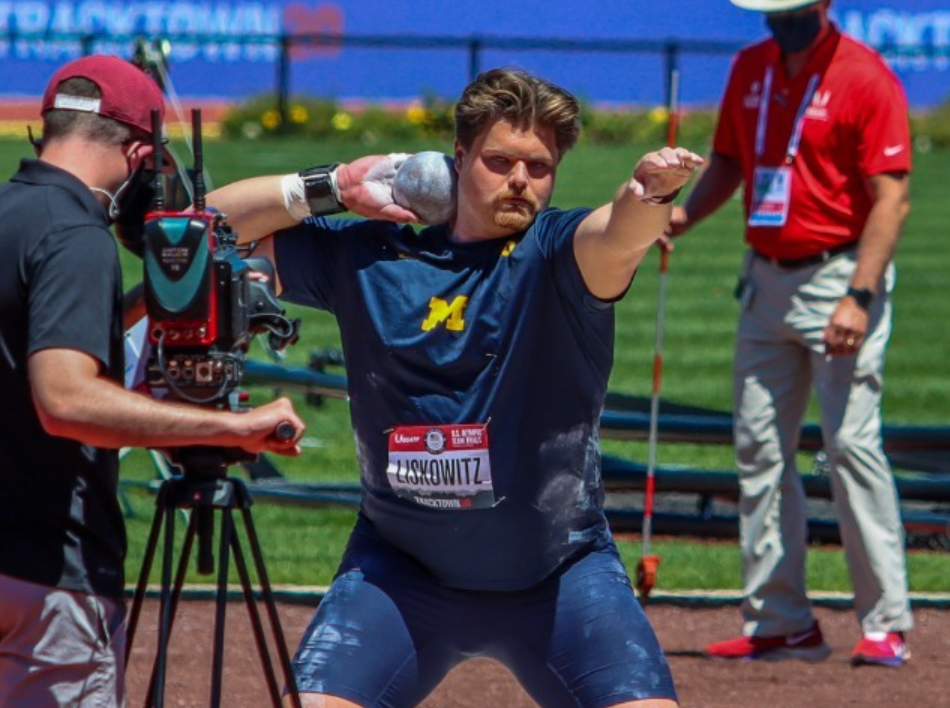
Q: Did you throw different shot weights? Marks?
AL: We would throw a couple different balls each session depending on the time of year. Once we found the heavies were my bread and butter, we stuck to those. We’d have a heavier day, then a heavy and mid-weight day, it just depends.
In terms of marks and distances, I really found a groove with the 18 lb my 6th year. I had a couple sessions where I was throwing the 18 lb 20M, from 19.80 to 20M. I remember this vividly: we were at Illinois for Big 10s and during the [pre-meet] I’m supposed to be throwing a 16, but I accidentally threw an 18. It went 20M, but Clayton was like, “It could have been a little better,” and John Meyer rolls back the shot and goes, “it’s an 18 lb.” Clayton was like, “Oh, good one!”
That’s when I was really getting the heavy balls going. During championship season, I liked to throw the light balls far, but I wouldn’t find the technical groove as easily. My 15 lb was always my indicator ball for me. My session before the first time I went 21M, I just finished orientation for graduate school and was bombing them at practice. Lifetime PRs with the 15 lb. I felt I was going to kill the meet and then hit 21M.
As I got older, I lost my feeling with the 15 lb for it to be my indicator. I found if I got into a groove with the 14 lb, then that translated to my feeling in the competition. I’m pretty sure I had 5K over 24M during that 2019 year. I trained between 5K–9K (11 lb to 20 lb) depending on what Clayton saw.
Q: Did you train partial throws? (i.e. stands, halves? If so, how far?)
AL: It’s funny, my stand is atrocious. If I saw 16M in a stand I felt I’d break the world record haha. I always got 4.5 to 5M from my stand to spin. It was more of a training tool and more to feel yourself working the ground.
My best half turn was maybe 18.50 with a reverse. I think I might have touched 20M a handful of times with the non-reverse [full]. I’d also do static non-reverses and it was a tool that helped me a lot.
Q: Who were your technical models?
AL: When I switched to a narrow base, I really was watching a lot of Mostafa [Hassan]. Coach Bedard at Colorado State does a really good job. The way he coaches the entry into the ring is cool and an efficient way to move. The force [Mostafa] gets on his push and how low he gets that sweep plus his natural hip rotation was just the type of rhythm you want in the throw. A lot of him.
For younger models, I think Kovacs is a good basic model. He has incredible technique, but his strength also allows him to have a simplicity in his technique that works so well.
Q: Most overrated thing about throwing training?
AL: That’s an interesting one. I think a lot of things can be accomplished in throwing without being a meathead in the weight room. Obviously, the weight room is like a 50/50 split for the sport, but when you’re grinding reps in the weight room you are making yourself so much more prone to injury.
As a thrower, you want to be quick and move as efficiently as possible. If [training and lifting] is translating into the throws, that’s all that matters. The key to the sport of throwing far is not [dependent on] being a crazy powerlifter or weightlifter.
Q: After Michigan, you trained post-collegiately. How was that experience? Working?
AL: I was down at LSU for the 2021–2022 year. I loved it down there. It was good to be in such a focused track environment. The history of that place and the throwing ring was right outside Tiger Stadium.
I was working on the side. I was really fortunate to get a work-from-home position with a real estate firm from California. I was just so lucky to get it. The CEO of the company was at the Trials and one of the programs I was in post-collegiately put a notice out for work. I sent my resume in. It wound up that his daughter was a Michigan alum and I had a real estate certificate from Michigan. I worked 15–20 hours a week and subsidized my training. I was able to make it work part-time.
I went back home to NJ for 2022–2023 and I had the ACL injury and was doing PT there.
Q: Describe your competition mentality and energy. (i.e. aggressive? calm?)
AL: I think that evolves over time. The more competitions you get in, the more you build your competition mindset. You realize with more time and more competitions you need to be as relaxed as possible.
Q: What motivated you to wake up every day and throw far?
AL: I had a belief in myself that I could be really good.
I was so grateful for the opportunity to go to Michigan and train with Coach Clayton. I thought I owed it to myself to see what I could accomplish. I think Kalnas put that belief in me too.
You are a product of your decisions. I had the opportunity to live with guys I liked to go out with in the track house or live with Grant Cartwright and Joe Ellis and become a gamer. You need to be disciplined. For my goals, I have to live with Joe and Grant a few miles off campus.
Q: I asked Andrew about how he balances producing high-level throws and any potential inconsistency throughout the season.
AL: Our goal was to throw far during championship season. We had a good streak of performing at Big 10s and hopefully lining one up at NCAAs. That was the goal. The training was structured to have the big throws during championship season. When you have a down meet throughout indoors or outdoors, it was “this is just part of the training.” Just wait for Big 10s when the body is feeling good and everything is going to line up. It was easy to trust Coach Clayton. When you’re peaking, your body just feels different.
Q: What do you do now?
AL: I’m going to be the throws coach at Monmouth University. I’m really excited to get going here in a couple days. I want to create a powerhouse throws program in NJ. I want these kids to stay local and build upon the throws tradition NJ has.
Q: Was the transition to a life without throwing hard?
AL: It is hard. I still have dreams of one day maybe getting back into throwing when my body heals from the surgeries I had. There is always a thought in the back of my head of not reaching your full potential. You have to dedicate yourself to this sport so much that it becomes such a big part of your life. It becomes who you are. If you don’t have the hobbies or a good balance outside of track, it can become too much for you. Once you’re done... it’s like "what do I do with myself?"
I love the sport, but I didn't quite get to achieve what I wanted. But now it’s my turn to help others with their goals in coaching.
Q: What is your fondest high school and college track and field memory?
AL: I just remember my team in high school (Christian Brothers Academy) was really competitive with Taylor McLaughlin's high school (Union Catholic). We’d be competing for state titles and it would always come down to the 4x400 relay. We had a really good 400M runner. But we’d need a 50M lead because Taylor would run a 45-second split on the 400. Seeing the battles between my school and his school.
Then, Taylor came to Michigan at the same time I did and we became great friends. He had a lot of success as an athlete and was able to achieve the Olympic Standard while in college.
For college, I think it’s the step outside of track. I really miss traveling to meets or getting breakfast with five of my teammates. And then you get to see them tomorrow and do it again. My most active group chat is still with my college track teammates.
Q: Looking back on your career, how has the strong tradition of NJ throwing influenced you or given you a sense of pride?
AL: It definitely gives me a sense of pride. Seeing someone from NJ in college is like a tight-knit community. I’m more inclined to say “hi” to a random NJ person than someone else haha. I was always chasing Josh Awotunde for the best NJ thrower. He’s a great dude and an incredible athlete. It was a sense of pride to try and be the best thrower from NJ, especially from the vast success we have had as a state.
Bonus: Any advice for younger throwers looking to improve?
AL: Try to do everything with intention. You need to be focused. It’s okay to have fun, but when it’s time to work you need to lock in. If you have a consistent work ethic or be intentional with your effort, it will really help achieve results.
Jordan West, Rahway High School '17, University of Tennessee '22, University of Arkansas '23
12 lb Personal Best: 67'10
16 lb Personal Best: 20.80 (68'3)
3x Meet of Champions Winner in the Shot Put
2x Meet of Champions Winner in the Discus
2x SEC Champion
7x NCAA All-American
*Date Interview Taken: 11/1/24
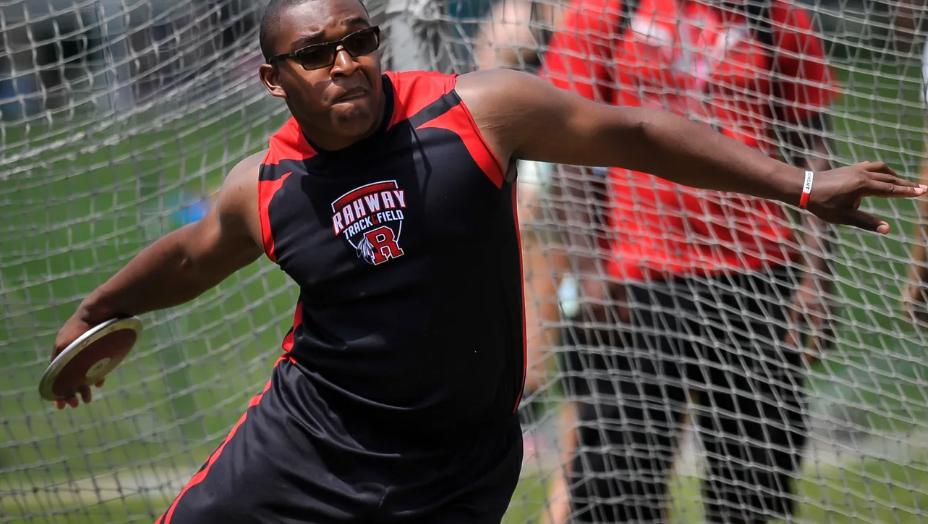
Q: Jordan, can you give a little background about your start in throwing?
JW: I was introduced to the sport of track and field in middle school. At the time, I was doing baseball, but they started doing middle school track and field -- like knowledge camps. I saw shot put, but didn't really see discus until I got into high school. I didn’t pick a shot up until probably freshman year of high school. But, I basically got introduced to it through a family friend who was the head coach at the time.
Q: When did you think that you could throw really far?
JW: I’d like to say freshman year just because I had a lot of time [to develop], but I didn't think I would get close to 60 feet until my senior year. My freshman year, I was watching people like Jason Bryan and Nick Pulli from Rumson and West Deptford. Those were the only two I saw in person my freshman year that threw over 60 feet. I thought that was a really good barrier for me, but I didn't really start touching that until my sophomore year.
Since freshman year, I wanted to try and throw far, I just didn't know how far I’d actually end up throwing.
Q: What was your progression in high school, college, and professionally?
High School:
Freshman Year 2014: Shot: 41'5.5, Disc: 129'8
Sophomore Year 2015: Shot: 56'2, Disc: 179'9
Junior Year 2016: Shot: 65'1.25, Disc: 190'2
Senior Year 2017: Shot: 67'10, Disc: 203'6
College:
Freshman Year 2018: Shot: 19.79M, Disc: 50.35M
Redshirt Year 2019: Shot: 20.33M, Disc: 51.35M
Redshirt Sophomore Year 2020: Shot: 19.26M, COVID-19
Redshirt Junior Year 2021: Shot: 19.98M, Disc: 56.59M
5th Year 2022: Shot: 20.33M, Disc: 53.45M
6th Year Year 2023: 20.76M, Disc: 55.51M
Professional:
2024: 19.99M
2025: 20.80M
Q: Why did you choose Tennessee?
JW: I chose Tennessee for a number of factors, but my main two were affordability and feel. I really liked Coach [John] Newell, he was my favorite coach of all the four schools I did visit. Financially, they were the best package.
Q: What was the hardest part about adjusting to the 16 and 2kg?
JW: I had a lot more learning curve with the discus than the 16. The summer before going into college, I ended up throwing 18m with the 16. Granted, it was blowing out the front, but I saw capabilities were there. I think just adding more technical cues and getting a lot bigger to throw a heavier ball because I’ve always come to the fact that mass moves mass. The heavier you are while moving well, the farther the ball will go. You want to be strong and not just be doughy.
Adding size helped a lot more in the shot than the discus. The discus is a little bit harder. I had to get a lot more technically sound. In high school, I was more offset, where I had my left foot at 12:00 and kind of kicked my way around the circle in discus. I had to break that habit, which took a little bit of time. Longer than I thought it would.
Q: Jordan, you had an unbelievable freshman year of college, throwing 19.79 as a true freshman. Walk me through that and the changes you and Coach Newell made.
JW: The biggest part of ending my freshman year with 19.79 was the way I thought about the throw. In high school, it was a lot about speed and not necessarily any rhythm.
My indoor freshman year, I ended with an indoor PR of 19.09. From that point, we saw there was a lot more that could be fixed. That fall, we worked on breaking down the throw and having more continuous movements throughout the throw, instead of being so-piecy or not really feeling positions. So, going into the first outdoor meet right after spring break, I opened my outdoor year at 18.88, which was very good. Right then we saw there was now good consistency. I wasn't sporadic or having any mid to high 17m throws that I was having indoors. Now I just got to work on hitting and feeling those positions a lot more. Getting more reps and feeling the positions more definitely helped me gain almost another meter from my indoor PR.
Q: After you made those successful changes, what was the long-term vision for the throw next?
JW: Well, the long term goal I wanted to graduate throwing 21m. I came a little short of that, but I really can’t complain. Everyone’s journey is different. I felt if things would had been consistent in terms of not having COVID, not getting Mono [my sophomore year], just like a consistent 4 or 5 years of training I felt I could have hit that goal with flying colors. Life changed for a lot of people, I have no gripes about it I just wish things were a bit more consistent.
Definitely being a top contender in terms of the conference and nationals was our big goal moving forward. My freshman through junior year, we were really looking at Stephen Mozia’s entry into the circle (Mozia is one of the 7 20M throwers from NJ). Coach Newell coached Stephen post-collegiately for several years. He took some of the concepts that he and Stephen were working on and tried implementing that to my technique. I think it helped a lot. Having a nice and fast, but controlled left arm out of the back. I felt like that and holding the middle like he does because [Mozia] has a really good wrap. He is not the biggest thrower, but he’s strong and hits positions very well. So, that is something we tried to emphasize from my freshman year to the beginning of junior year.
Junior year and on, was mainly transitioning to getting a lot wider right leg out of the back and trying to feel more back in the middle. Staying back is something I still have an ongoing issue with. It’s still a habit we are breaking, or have been trying to break.
Q: Jordan, you had a great double in high school, with 203’ in the discus and 67-10 in the shot put. In college, you became more known as a shot putter. What was it like trying to do the double, and what made you excel more in the shot?
JW: We prioritized shot earlier on. Going into my freshman year, Coach Newell saw that I could be a good player and score points right out the gate as a true freshman. With U20s coming up, I think my senior class of 2017 already had a couple guys over 200’ in the discus. We had Turner Washington, Elijah Mason, Jonah Wilson, Gabriel Oladipo, so those were all guys that threw the 1.6kg discus really well in high school. I was up there, but i wasn't as consistent. In my high school career, I only had one throw over 200’, my other throws were between 190’ and 195-198’. It wasn't a high priority, but I definitely wanted to improve in the discus. The adaptation of high school to freshman eating definitely added to me being a lot better in the shot than the discus.
Q: What makes Jordan West throw far?
JW: Me being a 6’ shot putter, I’m on the smaller end of course. Smaller doesn't mean anything, you got Joe Kovacs who is sitting at 6’ tall, Tom Walsh, both who are under what people would say is standard height for a shot putter. For me, it helps to have a 6’10 wingspan, while being 6’ tall. I can get over the board a lot more and add a lot more path to the ball. Being really high wired, I was pretty explosive in high school. I was able to grab rim with little effort. But, gaining 30+lbs puts a little more damper on your bunnies haha.
A combination of really good attributes -- levers and good explosiveness helps me throw really far.
Q: What are your weaknesses as a shot putter?
JW: Physically, some of my weaknesses are my height, but in terms of physicality I’d say probably my squat. A lot of world-class shot putters squat well over 800lbs. If I was to put a 1 rep max on it’s probably about 720lbs on a good day. My leg strength is one of the weaknesses I’m trying to improve upon year by year.
Another weakness of mine would probably be time, being a post-collegiate athlete without the resources you have as a college athlete. I have to work consistently about 36-40 hours a week while continuing to train and lift. It’s difficult, but not undoable.
Q: What are your strength levels?
Bench: 545 lbs
Squat: 745 lbs
Clean: 385 lbs
Snatch: 305-315, from the ground.
Q: What is a typical training week for you?
JW: Currently, I am lifting 3 times a week. Monday, Tuesday, and Friday. Throwing wise, I’m throwing 3 days a week, similar schedule but I do take Tuesday off and throw Wednesday. So, Monday, Wednesday, and Friday, with a drill day between Wednesday and Friday.
Q: What makes a good throwing athlete?
JW: Physical attributes is one of them, but I also think the ability to push oneself with self-motivation.
Q: Did you throw different shot weights? Do you have any favorites?
JW: For me, I like throwing the light implements because they go farther. The ones that translate to my throwing is the 14 and 14.5. I do enjoy seeing them go far and it’s a confidence boost. It correlates really well to my competition throws, so whatever I’m throwing with that I’m usually expecting to throw exactly a meter below that.
My second favorite is probably the 18. I was able to push that 18 really good my senior year at Arkansas. It really showed later on in the year. My best ever throw with the 14.5 was 21.76, my best ever with the 14 is just over 22, and my best throw with the 18 is 19.35-19.40.
Q: Do you train a lot of partial throws? If so, what distances have you focused on?
JW: Yes, I think they’re very important, especially in certain times of the year. I think in the Fall, it is important to do a lot of nons to get that block situated and honed in. I also think it’s important doing static nons because a lot of people don’t feel the left out of the back and it’s important to get your weight over that foot and push off of it.
My best stand reverse in training is about 16.90, my best half-turn non is probably 18.25, and my half-turn reverse 19.01 measured but I think 19.30 in a warmup. My best full non is 19.80 senior year at Arkansas.

Q: What other training do you think helps with the shot?
JW: I feel like a lot of twisting drills, like bar drills, seated or walking twists with a barbell is important to build that mobility in the thoracic area. Building hand strength and thoracic mobility I think are the two most important things in building an efficient shot putter.
Q: Who are your technical models?
JW: It’s evolved over the years. I think high school through my sophomore/junior year of college it was Reese Hoffa. Mainly because we are similar in height and attributes. I slightly transitioned to Tom Walsh as I tried to get more wrap in the middle. Now, me being a little bit bigger I transitioned to more of Joe Kovacs’ technique.
Q: What is the hardest part about throwing?
JW: You are sort of like the lone wolf. You are there, but no one knows you’re there. A lot of people see the glory in the track events, and some field events like the long jump and pole vault, which are highlighted more than the throwing events. Sometimes you may feel like no one cares. Having some sort of eyes on you outside of just your throwing group and encouragement is definitely beneficial to any athlete, but especially to throwers. Throwers are more set outside and do their own thing to get ready for the season. I’d say feeling like it’s a team atmosphere without having that support.
Q: Can you walk us through your decision to transfer to Arkansas?
JW: I wouldn't even say it was really a decision. I don't want to say it was forced upon me, but it was a decision I had to make it if I wanted to continue to train and be a collegiate athlete. In the Spring of 2022, our head Coach had gotten released. It is important to realize that the 2022 season the men’s team finished 3rd both indoors and outdoors. They brought in a new head coach by the name of Duane Ross. I had meetings with him and his staff, it became apparent that I wouldn't be getting the same financial package that I would have, which is what pushed me to look elsewhere. It just so happened that [Coach Newell] was going to Arkansas, so [I thought] let’s stay in the same conference and show them what they missed out on. Luckily, [Arkansas] won indoors and was 2nd outdoors.
Q: After Arkansas, you followed Coach Newell to his new job at Vanderbilt. How was your first experience as a post-collegiate?
JW: It’s definitely tough. After throwing 20.76, I made the move to Nashville in October and found a job at the airport. It allowed me to train in the mornings and work in the evenings, it’s tough on the body. It was definitely a fun experience.
Q: Where are you training now and how are you making it work as a post-collegiate?JW: I do not train at Vanderbilt anymore. Coach Newell got the associate head coaching job at Kansas State, which I’m ecstatic for him about. He’s been a very instrumental part of my life and my training career. I still do talk to him time to time, but he is no longer my hands-on coach. I’m transitioning to being coached by Dane Miller at Garage Strength in Easton, PA. I will be getting back up North in mid-November. I feel I thrive in a group atmosphere.
Q: What are your goals?
JW: Moving forward my goal is to train through 2028 LA Olympics. I’m trying to make that team. But, I feel I have to get a lot stronger and more technically sound to have a great shot at it. I do feel this year was definitely a good stepping stone toward that, I made the Olympic Trials final. After that, I want to get into collegiate coaching. I have coached several high school athletes. I have a little bit of experience coaching young athletes, but I feel like I need to get more experience coaching athletes who are in the high school/collegiate transitioning period.
Q: In one sentence, describe your meet mentality and warm-up like?
JW: I stay in my lane.
Q: What does your lifting look like in peak season?
JW: My championship season lift is more partial movements. Lot of pad bench. Lot of box squats, mainly half and up. As we get into championship season, it’s more like a quarter squat, but still pretty heavy. I think the most we’d put on the bar for those quarter squat lifts is like 900lbs. Just working on explosivity of the muscles. And a bunch of plyos.
Q: What motivates you to wake up every day and throw far?
JW: I think what motivates me is that fact theyre are people getting better. I have always had the mindset of “if I don’t do it, someone else is.”
Q: What is your fondest high school and college track and field memory?
JW: My fondest memory in high school would have to be my sophomore year in 2015. That year, I had an indoor pr of 54’-2, but going into [outdoor] Meet of Champions it is not based on your PR but how you performed at the sectional meet. I believe at Groups, I threw like 48 feet and got sixth, so I just made it in to the state meet. I was in the first flight of three. At Meet of Champs, I opened up at a 52’ throw, which held on to make the top 9. I ended up throwing 56’-2 on my last throw at that state meet to get third, behind notable athletes like Luke Grodeska who won and Andrew Liskowitz (one of the 7 20M NJ throwers since 2010). My second one, in 2017 Penn Relays, Roje Stone won and I got third [in the discus]. I competed against him in high school, was teammates with him in college [at Arkansas], and seeing him win an Olympic Medal is definitely something I hold near and dear to my heart.
My finest college track and field memory I’d say is winning SECs in 2023. After transferring to Arkansas, I knew it was going to be tough [to win]. I was trying to retain that outdoor shot put title. It just so happens that me and John Meyer are pretty good friends, but Indoor SECs was at Arkansas on our home turf and he won and I got second. Definitely stung, but outdoors was at LSU and [I won].
Q: Looking back on your career, how has the strong tradition of NJ throwing influenced you or given you a sense of pride?
JW: Being apart of one of the smaller states [compared to] Texas, California, New York, Florida, [which] lead the pack of high school athletes going to college and doing well gives me a good sense of pride. I grew up watching Nick Pulli, Sam Mattis, Braheme Days, and a couple of our guys compete. The fact that I put in the time and hard work to put myself either around their level or at that level, and hopefully done the state of New Jersey proud. Being a 20M shot putter and getting All-American in various years, it’s definitely a good sense of pride. And knowing that the great state of NJ has great throwers is important and something I hold near to my heart.
Bonus: Any advice for younger throwers looking to improve?
JW: I’d say comparison is the thief of joy. If you are in the sport to hopefully compete collegiately, don’t focus or compare yourselves to others. Simply, do the best that you can. Please don’t hesitate to use social media to message throwers you may follow or coaches you follow for tips. Or just find a club in your area and ask their coach for help. Don’t be a stranger to the throwing community.
CJ Licata, Gill St. Bernard's School '18, Princeton University '22, University of South Carolina '25
12 lb Personal Best: 65'1.5
16 lb Personal Best: 20.51M (67-3)
2x Meet of Champions Winner in the Shot Put
4x Ivy League Champion
5x NCAA All-American
*Date Interview Taken: 12/23/25

Q: How did you get your start in throwing?
CL: I got my start in throwing freshman year of high school. I grew up playing mostly basketball and a little lacrosse. But, going into high school I was getting tired of doing it year around and wasn’t having as much fun as I used to. I actually did cross country in eighth grade in order to stay in shape for basketball with some teammates, so I did that again my freshman year. I actually raced a bunch of 5k races. Not fast, but I think I learned that I really enjoyed working out and pushing myself. During the cross country season, I met some throwers that would work out and be part of the team but wouldn’t actually race and they mentioned to me “hey, you should start throwing because you’re a tall guy, pretty athletic, and should come out for spring season with us after basketball.”
So, I played basketball that Winter and then after that I quit and did track that spring.
Then the next year, I did indoor and outdoor track and then it went from there. I wasn’t particularly good for the first two years. That being said, I had no idea what I was doing. It was a very small program with a jumps coach doing the throws. I threw shot, disc, and javelin at the time. For a while most of my teammates and I actually thought our school record was 39 feet in the shotput, which actually turned out to be false and was 56’ or so, but that summed up how naive we were about throwing haha.
Q: Tell us about your sophomore to junior year improvement from 41’ to 61’?
CL: After my sophomore seasons I had PBs of 41’ and 131’ in the discus. And 143’ in the javelin. My sister was in college in Massachusetts and we went to visit her and also toured Boston. I remember watching the 2015 World Championships Shot Put in Beijing on YouTube in the hotel room nonstop. It is silly that for two years I did track, but really never watched a single video of technique or the pros. But, watching that I thought “I want to be that good.” I think it was seeing world class throwers with full confidence in their technique that was so motivating.
So, my Mom found a throws coach through a referral of an elementary school principal we knew whose daughter threw. That was Mark Mirabelli. He was located about 90 minutes away, but he knew how to instill a sense of motivation. He told me that if he didn’t see improvement from me working on it at home after the first session to the second session that he wouldn’t let me come back because he didn’t want to take the time or money from my Mom’s day. Well, I worked. I saw him 3 times in the Summer, and somehow YouTube clicked for me and videoing myself. I must have had hours of video footage over those months.
The one funny thing I think about is how I liked javelin the most at the time before seeing Mirabelli. But, he pushed me to start training the shot and discus, and we would do the javelin at another time. Imagine if I did javelin first. Life could have been different.
Q: When did you know that you could throw really far?
CL: I’d say my junior year of high school. I went to the Molloy Stanner Games Meet at the Armory in January. I opened up at 55 feet in December and then the following meet I went 57 feet. Then, this Meet came along and I actually went against Jordan West. It was my first time competing against anyone better than me this year. I remember my first throw completely slipped out of my hands and went right around 50 feet. And I kind of thought to myself “maybe my luck has run out“ and then about two throws later, I caught a 56 foot toss and then realized it wasn’t really luck. I was very good and my technique was coming along, but I think that gave me a lot of confidence that I could actually do this and keep progressing. That whatever I was doing was working. That year was very special.
Q: What was your high school and college progression
High School
2015 Freshman Year: Shot: 32’, Discus: 99’
2016 Sophomore Year: Shot: 41’, Discus: 131’
2017 Junior Year: Shot: 61'8.5, Discus: 167'4
2018 Senior Year: Shot: 65'1.5, Discus: 184'6
College:
2019 Freshman Year: Shot: 18.27M, Discus: 47.96M
2020 Sophomore Year: Shot: 18.97M, Discus: Covid-19
2021 Junior Year: Shot: 19.90M, Discus: 54.79M
2022 Senior Year: Shot: 19.77M, Discus: 56.95M
2023 5th Year: Shot: 18.27M *One Meet, Right Pectoralis Injury
2024 6th Year: Shot: 20.51M
2025 7th Year: Shot: 20.46M
Q: Why did you choose Princeton and the Ivy League as a whole?
CL: I started to get recruited in February of my junior year, and started to look at a lot of the Ivy League schools, specifically Harvard, Penn, and a few others. I also looked at William and Mary. I realized that I really wanted to push my academics as high as possible, and the fact I could leverage track and field was extremely enticing. But, I also wanted a program that I felt could push me athletically, and I wasn’t reducing myself by going to the Ivy League opposed to these bigger schools where athletics are a lot more of the focus and there’s more resources to do so. It was July going into my Senior Year and I was basically all but committed to Harvard. If they had me commit right then I would have, but we wanted to do the official visit and make sure all the academic stuff worked out accordingly.
Fred Samara, the head coach and throws coach at Princeton at the time reached out to me in July. I had brief contact with him a few months prior, but he didn’t really recruit me yet and I didn’t really follow up much. But, then out of the blue he reaches out to see if I was still interested. I literally said to my family “what’s the point?” Well, good thing my parents said I should still look into it. I didn’t think I wanted to stay in New Jersey, but then when I went down to Princeton and then Samara took a visit to my house. In about 5 minutes, we all knew that Princeton was the easiest choice. He just had a wealth of knowledge and his track record was second to none. They had a really great group there and I think it was just an easy decision in terms of the academic reputation, the school spirit, and everything that encompasses Princeton. The fact that their track team alone had gotten first or second of the Ivy League in the last 25 years and they’re throwing through was so top-notch, I felt that if I really wanted to go to a place and not reduce my potential then it would be there.
I also switched coaches from Mirabelli to Tony Naclerio, who knew Samara from his coaching days at Iona and Rutgers. That helped a lot too. I think coming from a small school with a very, tiny track program helped when it came to the emphasis of team culture that Samara highlighted as well.
Q: You threw 18.27m indoors as a true freshman. How?:
CL: My freshman year I learned a lot. A lot of technical changes from Samara really helped. We changed how I came out of the back in the glide and my entry and just the throw as a whole. I think my junior in high school I was really fast, but very raw and a little bit ugly with my technique in certain spots, but I was very powerful and quick and used that to my advantage. Then, my senior working with Naclerio, he really taught me about throwing and technique. I actually felt like I finally had answers to a lot of questions I had from the year before when I was very raw. I do feel like I was almost too technical and a bit slower and trying to hit positions more than speed. I think when I look back to my progression my freshman year at Princeton, Samara really reminded me how much speed kills, especially with the 16 pound and how you have to be dynamic. He really liked the model of Alessandro Andrei to really go off of and how you want the throw. Samara had me throw lots of 14 pound as well which I think ironed out my speed, plus the lifting really helped too. I think I went to Princeton at 260 lbs, but accidentally lost 12 lbs from their student orientation program and then I got up to 270 lbs. But, it’s funny because I was sidelined with with a hamstring injury around Thanksgiving that put me out for a 5-6 weeks and you know, I just did stand throw stuff and step back throws and different drills and by the time I healed from that I was already throwing farther. I don’t really know how.
Here’s a funny story about that. I was healing very good. I took my first glides again the week leading up to our home meet in January. I go about 16.50M, where my best training in November was 17.08M. The competition is Sunday and it’s Friday night and I’m walking back to my dorm. There is this huge stairwell you have to walk down outside by the courtyard. As I’m walking, I stupidly like miss a step, and as I catch my balance I can feel my hamstring just totally aggravate. I must’ve iced that leg for 36 hours straight haha. I took three throws in the comp and threw 17.53M, which was about 50cm farther than I had ever seen the 16 go. I have no idea how! But, the progress really did just snowball onto itself. But I think it was just a testament to the new technique out of the back and then just having a new coach and being a part of a great training group. I went 18M about a month later and then the 18.27 was at our conference meet and my first Heps title.
Q: What was the hardest part about adjusting to the 16?
CL: I think probably the hardest part with the 16 is understanding for me what I had to do to make it go farther versus the 12 pound. With the 16 you can’t get away with a lot. Also, just the fact that it’s heavier I think there’s just a lot more pounding that comes to the weight room and finding your technique. It’s hard to try to feel the ball sometimes because when you’re not that strong it just doesn’t go very far if you break it down too much. And I think that’s the major reason why I talked about how that whole speed kills concept was so important for the 16 versus the 12. You get away slowing it down with a 12, where you can still throw 60, 61, 62 feet, but with the 16 it’s hard to make it take off unless you’re getting everything into the ball. So, I think just revamping the technique that makes sure it goes in the 16 pound and actually just learning how to throw a ball that’s heavier and more unforgiving.
Q: What things have you had to overcome in your throwing career?
CL: I’ve definitely been a little bit unlucky with injuries here and there. It’s definitely the nature of the sport. I had full pectoralis reconstructive surgery on my right arm. That was the toughest. I hurt it in November of 2022 and tried to rehab it, but for six months it got much worse. I got surgery in June at the Hospital for Special Surgery in NYC and took a semester off of school. I actually have two achilles tendons from a cadaver in my pec. The tendon was intact, but the muscle was completely shredded. It was a bit complicated because you typically don’t get surgery for muscle on muscle. You literally could feel a divot in my chest. That was a low moment.
I remember that whole Summer it was like 90 degrees out, but I wasn’t allowed to shower for about 4 weeks and obviously couldn’t work out. I couldn’t even drive. When you go from working out 6 days a week for years and then can’t at all, it’s awful. I rehabbed it at home with a great physical therapist who is still a great resource and friend to this day, Brian Ireland.
I started throwing again in December of 2023 with Brian and then went back to USC in January. I did not really know if the pec could deal with it. We took January for stands and drills, where February we’d start gliding. Brian did all my workouts and even my throwing volume to start with Coach [Mike] Sergent back to coaching me. The crazy part is, when I started gliding in February of 2024, within 3 weeks I produced a lifetime training. I was finishing off the session with one more non-reverse and happened to reverse it and the ball just popped out. I don’t think I’ve had a single throw that was so effortless in my career like that. I think I yelled at the top of my lungs some expletives about how excited I was. It’s hard to describe a moment like that.
It is interesting having to take a lot of time off from throwing because it takes you out of your rhythm. There’s been multiple instances where I’ve had to take 3 to 5 months off of throwing and you know you have to get your rhythm back quickly sometimes. I think you always lose a little part of your prior self because you can’t just pick up where you started but at the same time I think you learn a lot in what you actually need and how you have to be adaptable. When I came back to USC after the pec, I felt like I had a clear mind on what I needed to work on to improve. Sometimes training can get monotonous and you can lose out on what is really lagging. During certain points of my career, I’ve had to change up how I lift and how many days a week I throw to get better and I think you start to learn that there’s not one single way of doing things there’s also multiple ways in itself to do it. It also forces you to change your mentality and how you can throw far.
Q: After Princeton, you spent three graduate years at the University of South Carolina, why did you choose UofSC?
CL: So, it’s pretty interesting because I was at Princeton for four years, but only competed in one outdoor season. I competed in the three indoor seasons, but I got injured with a foot surgery my freshman year spring season and then got hit with Covid-19 twice for the spring years my sophomore and junior years. So in four years, I only competed one time and the Ivy League has a unique role where you can not be a graduate student and compete. So there’s really not any redshirting because a coach would never have the incentive to do it because they would not be able to use you.
However, I was fortunate or unfortunate depending on how you look at it to get the three additional outdoor years and one indoor year. So during 2021, I got in the transfer portal that Summer and then started looking at other coaches and programs. I was between South Carolina and Alabama. South Carolina just had a smaller group and Dylan Targgart was there. I knew I would graduate with him and therefore would have a locked-in training partner for three years. Coach Sergent was there and he had a great Throwing résumé, plus Josh Awotunde was there and it was just such a perfect group for me to be into.
That was a pretty cool opportunity to see the dichotomy between an institution like Princeton, which is so academically rigorous, and the athletic resources are a lot less compared to a place like South Carolina, where the athletic side everything is at your fingertips. We used to just train all day.
Q: What was a typical training week for you at Princeton vs at South Carolina?
CL: I think one of the biggest things that has helped my throwing career in the last few years was the knowledge I gained at South Carolina. We had so much more time to train down there with less stress and other factors getting in the way of your training. I learned without a doubt ‘how to train,’ meaning what you did in the fall and what you didn’t do in the fall versus what you did in the winter prepping for season and what you didn’t do. Just how the months unfold and what you do with your throwing. Obviously, I learned a lot from Serg and technique. Some very important pieces that helped me throw farther.
To get a little more specific, at Princeton I would typically throw up about four days a week and the volume was pretty low. I think it got a little too low as years went on, which is not so great looking back, but the intensity was always quite high so it was always quality over quantity. I learned how to compete very well and the speed and timing we worked on in practice mirrored competition. Meaning we would throw hard a lot. We would lift about four days a week out of season and about 2 1/2 in season.
At South Carolina, my first year I went there I got hurt unfortunately pretty quickly in about two months and that sidelined me for a little bit over a year. I was still lifting lower body and working around it. But, there wasn’t much throwing let alone pain-free training. However, one of the biggest things that led to my growth was I increased my work capacity and just how much volume I could tolerate. I think one of my issues in reference in my senior year at Princeton was I really just ran out of gas. I could produce a lot of force, but that repeatability at times if it’s not trained can definitely burn out. At South Carolina, it was all about upping that volume. I remember my first Fall in 2022, we were doing reps of 10s, 8s, and 6s on the power lifts and even 6s on cleans. Compared to Princeton, we never did any lifts above 5 reps in my four years there pretty much.
So, when it got to the nitty-gritty, South Carolina had a lot more volume than I was accustomed to, but I think it really conditioned my body a lot better and a lot of different balls in practice. But, it did bang me up quite a bit too. Princeton was mostly 14-17 lb ball spread, where USC was 14-20 lb. But we would typically lift four days a week in the 3 to 4 days a week in the off-season and then about three in season as well. I threw 3 days a week and have a day where I go very easy. Which is something very different from Princeton. I took that from Awotunde and how whe trained. I think that’s been very helpful to work my form through varying intensities and speeds. You need to set the sequence before you can always go fast.
But, they were very different programs, but I think they complemented each other very well, especially in the order I went to them. I think if I went to South Carolina first and then Princeton I would not have had the results that it would’ve had if I went from Princeton to South Carolina. I learned at Princeton how to compete and practice aggressively and I brought that mentality to South Carolina. Where USC taught me how to train and be a little more patient with things and and just how your technique must come along over a few months and not always today.

Q: What are your strength levels?
Bench: Had done 410 in 2022, but surgery made me have to restart any progress. Have done 375 x 3 since surgery.
Back Squat: 600 lbs in 2022
Hang Clean: 374 lbs in 2021, I don’t catch anymore. Just pulls.
Hang Snatch: 285 lbs
Vertical Jump: 35 inches when I was 290 lbs
Standing Long Jump: 10-2 at 300 lbs
BTN Jerk: 462 lbs
BTN Push Press: 405 lbs
Q: What makes a high-level throwing athlete?
CL: I think what makes a high-level throwing athlete is someone that can move very well and can fire quickly. They must be athletic, but you need someone that isn’t afraid to be aggressive in the way they compete. There are a lot of different frames and styles that make people throw far or farther than others, but it really is a skill and comes down to who can figure that out and apply the most force through their technique. That takes a special type of athlete to do that effectively.
Q: Did you throw different shot weights?
CL: I do throw different weighted shots. As I said before at Princeton, we threw a lot of light balls around and the idea was keeping the rhythm and timing whether we felt good or bad from the weight room or anything else and just trying to get the throw and practice to move like it wood in competition year round. That doesn’t mean it had to always go far but we were chasing the movement and I think that actually is really important because with throwing. You need some positions, but you also need good movement and rhythm. Positions without any movement or speed does nothing, but also a movement or attack without any good positions also isn’t great because you can’t hold any tension or get any separation. I think Princeton’s style was good, but I think at times it might’ve gotten a little bit monotonous.
Where in South Carolina, we added a lot more heavy balls and I think that is something I’m still exploring now. I think you always have to keep the volume and intensity in check not only for keeping yourself healthy and not getting injured, but also understanding how it could affect your timing in the short term. The last
Some of my marks are the 14 lb 21.43M, I’ve thrown the 8kg over 19M and then I’ve thrown the 16 lb a few times over 20M. It just depends especially if you are hurt or trying to just feel certain things because it’s not always about making the balls go far. I could say the last few years I’ve probably only thrown the 14 pound shot probably a total of 8 to 10 times, so it’s all relative to frequency and timing. The heavy balls is something I’m still exploring and trying to find the balance of making them go far and hitting them versus using them as more preparatory to complement my 16 lb.
Q: Did you train partial throws? (i.e. stands, stepbacks? If so, how far?)
CL: I train lots of partial throws. For gliding, I do use stands, stepback throws, and non-reverses. I would say I used them to get different feelings or prime my body to attack the throw. It depends on what I’m trying to do for that practice. South Carolina was also interesting because Serg made me do a lot more non-reverses. In my early career with Princeton, I used to do a lot of non-reverses. But, we actually got away from them and it actually worked pretty well for a while and then I started to run into some issues of leaving the ground quite early and being too vertical with a high release angle and that was a recipe for not so far throws. The last few years it’s been all about using the ground and learning how to do that again, which was pretty monumental and getting me back on the right track and then some. But, some of my best I’ve seen is a 16 lb stand 17.47 in training and an 18 lb 16.10 from a stand all from a non-reverse. My non-reverses I’ve seen 19.50M with the glide with the 16 lb. With the step back throws it just kind of depends, but those give me a lot of really good feel and bridge the cap between the delivery and also feeling some things out of the back.
Q Who were your technical models?
CL: My technical models have definitely changed over the years. I used to watch a lot of Al Feuerbach in high school when I was coached by Tony Naclerio. With Samara, it was a lot of Alessandro Andrei and a little bit of Timmerman, Brenner, and people like that. I think at South Carolina, I started to explore more of the European style, which I always watched, but I had a harder time implementing in my throw or connecting it to my own. But you know, Coach Serg used to talk about how the left side could actually help your right side in accelerating and delivering the throw. And almost about using your hips turn in the delivery, but using that left foot and left arm to create a path and also create rotation to drive the shot through. I started watching more of Tomas Malewski, or even David Storl, and I started to connect a little bit more of a sling and a long delivery versus just thinking all about my right side and hip which is what I thought at Princeton.
Q: What were some big technical things for you that made the ball go far from college until this point?
CL: I think some big technical points was obviously changing my entry to a drop in glide because that would give me a little more vertical displacement and speed. Samara used to tell me that you know I’d have to squat like 1000 pounds if I wanted to still be in a crouch start like Al, just because there’s not enough momentum to really get out of it. It’s a hard position to get out of. It can require a lot of strength. In addition, I think with with Serg, he taught me using that left arm and even that left foot and how to help create a path meaning that if I reach the left arm out a little bit longer as I landed, I could keep my weight over my right leg and the ball back a little bit more. It used to be a lot tighter and my left arm used to fling up and this kind of hooked the ball quite a bit, especially my senior Princeton, and it led to a lot of left sector throws and a lot of lost distance. And I think currently some of the things I’m working on is using my right knee a little bit more out of the back and initiating the throw with that. That is something I got from sending my film to Storl so he could analyze.
Q: Most overrated thing about throwing training?
CL: This is a difficult question, but I guess I would say the most overrated thing would probably be quantity over quality. I think that goes without saying, but it’s very easy to get in the habit of doing more drills or throws for the sake of doing more throws just so you could check a box. I think it’s really ineffective for a lot of people. It depends on the time of year and what your goal is, but I always think it should be quality over quantity. You really shouldn’t have any throwaway reps at practice where you gave up on the throw. I do think you want every throw to be independent and be very focused. I think when I was younger, this probably got me hurt because I had the intensity a little bit too high for the volume. Throwing isn’t a lift where more sets of more reps always equals adaptation or improvement.
Q: Why do you still glide at this point, even with all of the recent rotational success?
CL: I got into gliding in high school and stuck with it. I threw the discus relatively far, 184’ in high school and 187’ in college. I briefly experimented with a spin in high school and never really felt confident or strong with it. Discus and the entry was quite difficult. I ran very linear and could catch it back for a good throw. I think the acceleration pattern was pretty hard for me to push left and get wide. My hips really don’t want to do that. Where I felt with the glide, it was super natural for me to just explode out of the back and try to reach top speed and just hit the ball linearly. The way I could turn my right foot and hips also came pretty naturally.
I know some other people aren’t like that, but for me it felt really smooth to glide. I know, especially now there’s even more you know discussion about the rotation, but I felt very confident when I was looking in college that I did want to glide. People always talked about how you had to be so strong and all these other things, but I don’t know, I just looked at myself individually and I said “hey, I threw 61 feet which was a 20 foot improvement from my sophomore to junior year”. I only benched 235 pound and I clean and jerked 225. I had good jumping numbers and I could squat only 315, I had a good stand throw but was still getting about 10 feet conversion from a reverse stand to a glide reverse and thought at the very least if I just get strong, it has to go farther but I know my technique is also going to get better. I just thought how people talked about the rotation so generally to me didn’t make sense to the results and style I had. If I thought I needed to spin or that the glide was limiting me, I would’ve switched. I just didn’t understand how a pretty weak and new thrower like myself had to rotate to throw farther.
I’ve been through a lot of injuries and all have had successful comebacks from them and just something about the technique very much clicks for me. The biggest thing you have to solve for is yourself. I thought I had all the tools to be good and I just needed time to develop.
Q: What motivates you to wake up every day and throw far?
CL: I think what motivates me every day is a few things. I’m very competitive, so I always want to win and the fact that there’s always other people out there working trying to beat you is very motivating. The individual component because you’re competing against yourself and trying to be better than you were at your last competition, last practice, prior year, etc. is also what fuels me.
I do think I have a chip on my shoulder that I got into the sport late and was not a prodigy that was grown into it. Then, going to the Ivy League and definitely being a glider as well, where people don’t expect you to be as good as you are and I do like the idea of coming out and showing them I can be. If I had a dollar for every time someone said I should rotate or the glide is capped, I would be rich. That annoys me and makes me train harder. I get tired of people that don’t know anything about me trying to apply what they think is best.
Q: What do you do now?
CL: I finished graduate school in June at South Carolina. Now, I’m working and I’m a licensed investment broker. I’m still training full-time and things are looking quite good, so just looking to continue to build knowing I’m in a sustainable space to not only work and build my career, but I can also throw for as long as I want and see how I can keep getting better. I switched up my training schedule this year because now I train usually at 5:00 and after. Plus, I cannot do the long days I did in college, mostly from my work.
I coach on the side, which has been really fun, fulfilling, and I’m working with a lot of talented athletes at the moment and looking to see their improvements as well.
Q: How has the transition been from going from a collegiate training environment to a post-collegiate environment?
CL: I think the transition has actually worked pretty well. I always take a lot of thought in trying to figure out what I have to do next season to improve. Being banged up a lot the last few years, sometimes what you have to do is actually more apparent, or it’s easier to see perspective a lot more. I took the time on my own schedule to plan out what would be the best for me and what times I need to train. I use the weekends more to train now. I now have flexibility in the sense that I can decide exactly what I want to do. Day-to-day, week to week, month to month, or for the year. In the past, I’ve always worked great with my coaches, but you’re still dealing with a team. You’re still traveling to meets when they tell you or you’re still going to practices or dealing with doctors or athletic trainers. Now, I decide truly what is best for me on a day-to-day basis. If I don’t feel good, I can make on-the-fly adjustments. It is very freeing. No one can know how you feel as much as you can know for yourself.
I switched coaches to my Mom. She’s been following my brother and I’s careers closely and she helped coach him in high school a lot. She has a very extensive knowledge base from watching our careers over the years. I drive all the training, but it is nice to see someone who can watch you day in and day out and understands your throw. It is a tough sport to be completely solo I think.
Q: What is your fondest high school and college track and field memory?
CL: I would say my fondest high school track and field memory would probably be opening up my junior year indoor season at Lehigh University. I threw 55 feet which was a 16 foot improvement from last indoor season and 14 feet from outdoor spring. I was training really well up until that point and throwing consistently over 50 feet, but to finally do it in a competition that was real and legit you can’t replicate that feeling anywhere. That was really cool because I just knew my life had changed forever for throwing.
For college there have been a lot of them. I’ll give one in recent years, but I’d say definitely when I came back from pec surgery and opened up at Florida Relays in 2024. It had been a long and tumultuous recovery and training was going really well, even though it only started for about 10 to 12 weeks before the meet. I went to that meet and actually hit 20.00M, That really revitalized not only the feeling that I’m back and healthy, but was just very special because it was similar to my junior year in high school, where I really didn’t have any expectations. I didn’t really know what could happen. I just wanted to compete again and feel like myself. I knew I was in good shape, but it’s always special when things come together in a very positive way when you aren't putting so much weight on your goals or expectations.
Q: Looking back on your career until this point, how has the strong tradition of NJ throwing influenced you or given you a sense of pride?
CL: think the strong tradition of New Jersey throwing gives me a great sense of pride. It’s actually incredible the type of talent we have produced not only at a high school level, but also that goes on to a college and professional level as well. In 15 years, we’ve had seven guys over 20M in the shot. That is incredible. And I think it’s just great to see how hungry the state is for throwing. We always have many 60 footers in high school every year in NJ that are looking to level up and it’s just really cool to be a part of and stay connected to the high school track and field world here.
Bonus: Any advice for younger throwers looking to improve?
CL: I think the only advice I would say is study, study, study. Watch a lot of film and ask yourself “Are you doing everything you can?” I think it’s very easy when the season starts to be motivated when you have competitions and meets. Or when things are going well or you throw a personal best that is when athletes are focused. But, the real results come in the off-season or when things aren’t going well for you. It’s all about keeping the focus then. and making sure things are still fun is really important to keep your long-term growth. At the end of the day, it’s all about you, which is great because when you make it happen, it’s because you did it and you figured it out. On the flip side, it’s easy for people to lose a little motivation when you don’t have a coach on you everyday because it is a largely individual pursuit.
I like to tell the athletes I coach that just because you don’t have a coach yelling at you or a lot of other teammates or there is not constant hype for throwing, it doesn’t mean that it’s any less noble or admirable or challenging. So I think you have to find your own motivation at times day to day.


Comments