
Shot Put Greatness: An Interview with Mr. Al Feuerbach
Updated: Aug 3, 2025
DOB: 14 January 1948
Preston High School Class of 1966
Emporia State University Class of 1970
7x AAU Indoor and Outdoor Champion
3x Olympian in the Shot Put
Former Multi-Time World Record Holder
PB: 21.82M, 71-7
Date Interviewed: 16 November 2024
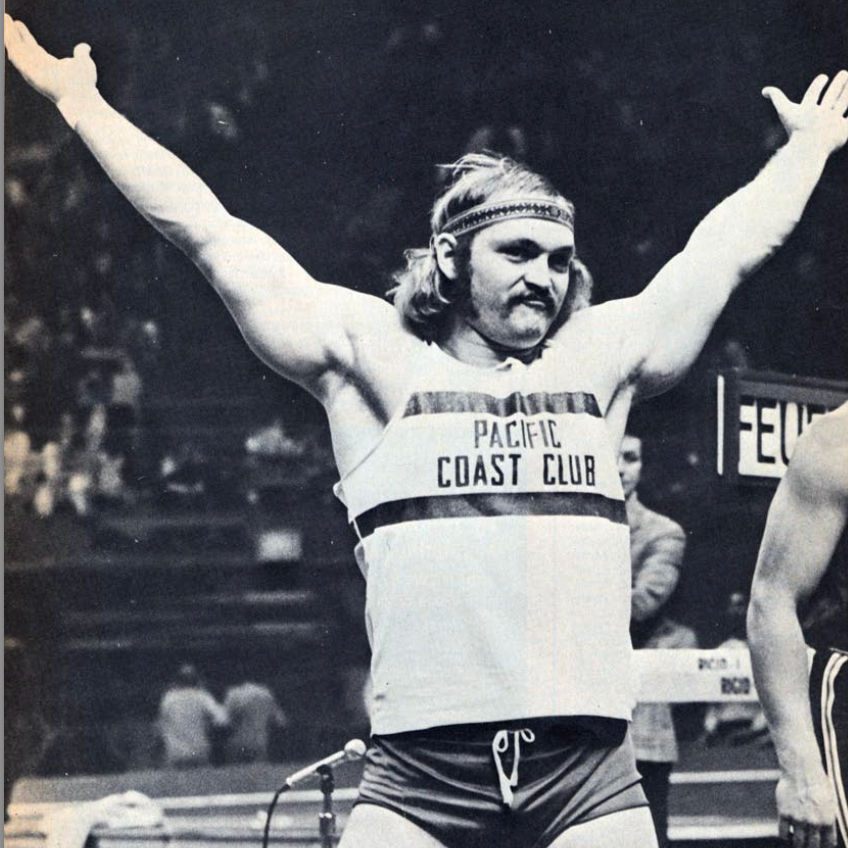
Q: How did you get your start in throwing?
AF: I went to a small high school and they started track and field when I was in 8th grade. We didn’t have it in junior high. My brother, Gary, was a junior and he brought a 12 lb. shot home and I saw it in the backyard. I picked it up, tossed it, and I was intrigued immensely by the idea of picking it up again and seeing if I could throw it farther than I did the first time. That went on for 22 years. Now, the reference here though is that I played baseball and basketball year-round and loved those team sports, but there was something about the shot put and the objective measurement of it. The fact you pull a tape measure to measure your own self improvement that intrigued me immensely. I threw 60-9.5 my senior year and weighed probably about 180 lbs.
*Feuerbach’s High School Progression with the 12 lb. Shot Put:
HS Shot Put Progression 12lb:
1963 Freshman Year: 37-9
1964 Sophomore Year: 47-10
1965 Junior Year: 55-5
1966 Senior Year: 60-9.5
Q: Can you walk me through your career at Emporia State and that development experience?
AF: Well, first of all I didn’t get offers from NCAA schools because of my lack of size as a shot putter. I don’t think that they thought there was a future. But, the coach from Emporia State, who was a shot putter, Phil Delavan, saw me at an all-comers meet in Des Moines in the summertime and recruited me to go to Emporia State, even though NAIA is not a full scholarship organization. He saw the potential; the quickness, all of that. So, when I arrived at Emporia State in the Fall, he took a look at me and I think he thought he made a mistake because he immediately went out and bought a crate of something called Nutriment to try and help put weight on me.
It was fantastic to go to Emporia State though. It was really the right fit to not be at a bigger school because at Emporia State I was just allowed to develop at my own pace. I won the NAIA National Championships as a Freshman in Sioux Falls, South Dakota, that was in 1967. It was 56-2.5 with the 16 lb. shot, so it was a very good conversion from a 60-9.5 12 lb. throw from the year before. I was winning meets, winning conference meets, maybe I could not have done that if I had gone to USC or a bigger school. So, it was really perfect. By the time I was a senior, I was throwing in the low 60s and I could really see myself knocking on the door of national class throwing. So, I drove my car on the day of college graduation (1970) at Emporia State first to Billings, Montana for the NAIA National Championships, where I set a NAIA championship meet record and then I drove on to Los Angeles, California to just continue training.
*Feuerbach’s Progression at Emporia State with the 16 lb Shot Put:
1967 Freshman Year: 56-2
1968 Sophomore Year: 57-5
1969 Junior Year: 58-9
1970 Senior Year: 62-5 and 65-0 that same year post-graduation
Q: What was next for post-collegiate training?
AF: Quickly, I’ll talk about Los Angeles. I was down there for a year and a half, training near USC and at USC. I was training with their throwers. They had a lot of good throwers. My friend, Dave Murphy, threw 65’, they had 200’ discus throwers, etc. But, after a year and a half, they were leaving school and that situation was breaking up. But, that was a very inspirational time for me. I set a world indoor record when I lived in LA. It was a meet in San Francisco, The Cow Palace, that was my first big breakthrough. [That] was when I was training in Los Angeles. I beat Randy Matson and set a new indoor world record.
I had met these guys from San Jose; Richard Marks, Lahsen Akka Samsam, and a weight lifter named Bob Kemper at a meet in Modesto, California that Summer. They said “oh man come to San Jose…it’s a great place to train.” And that turned out to be basically Mecca. Just the greatest place to train. I was one of the first to come, but there were already great throwers there; Ed Burke– Olympic hammer thrower, John Powell– discus thrower, there was already people there. San Jose just became a Mecca for training. People started arriving from all over the place like Fred Samara, like Bruce Jenner. I remember the day Bruce Jenner walked on to the field. We were out throwing at San Jose State, and he walked onto the field and went “Hi, I’m here to train with you guys.”
Mac Wilkins showed up from Oregon to train there. We became training partners, good buddies, and eventually housemates right here in the house I’m speaking from now. There’s actually too many people to name that were national class and world-class throwers. We coached each other basically. I can't say there was a real coach, there were a lot of people who supported us who were local coaches, but we were really analyzing each other’s technique and giving advice.
Q: Can you give us some insight into your so-called ‘breakthrough days’?
AF: The peak training after the Fall and Winter, basically broke down to every week we would have a breakthrough day in lifting and a breakthrough day in throwing. The breakthrough day in throwing would be on a Friday before the heavy lifting. Then, the breakthrough day of lifting would be on a Saturday. That’s when you went all out to try to get a new PR. Of course, there was plenty of training leading up to that during the week.
Q: What was the timeframe of your training in San Jose?
AF: For me, that tremendous period of training and camaraderie [at San Jose] was from late 71’ through the Olympics in Montreal. I then bought a house in the Santa Cruz mountains and started training up here, where I live now. Mac Wilkins, I invited him to live with me and train up here. He did that in 77’, I bought the house in 77’. The training thing in San Jose kept going with other athletes. There were other people still arriving in San Jose like; Mike Buncic, Olympian, Penny Neer, Olympian, and the list just goes on and on. It went on to the 80s for others. I wasn’t part of that particular training group at the point because I was training up here and there were people coming up to my house to train. People like Ian Pyka, Mike Weeks, Mickey Cutler, a whole lot of athletes.
Q: What was it like breaking onto the scene and becoming one of the nation’s and world’s best?
AF: Well, that would have been the indoor meet at The Cow Palace in San Francisco in 1971, when I defeated the great Randy Matson. The week before, we had competed in Los Angeles at the Sunkist Meet. I was an unknown. When they announced Randy Matson, they trilled the ‘R’ on his name: “RRRandy Matson.” He tied the world indoor record that night and I had two throws an inch and a half below him and I got no attention and no attention from him. I basically seethed all week long, prepared for this meet at The Cow Palace and exploded a 21M throw, 68-11, and broke the world record by over a foot. He broke the world record that night as well, but not as great a distance. I have the greatest respect in the world for Randy Matson, but he couldn’t quite handle stepping on the victory stand in the 2nd place rung. He kind of like lifted his foot up on it and then pulled it away and walked away. That was a very exciting night for me. First of all, just being this guy from the Midwest and being pretty much unknown and beating an icon in the event.
I could make another comment about breakthroughs. When I won the NAIA as a freshman in Sioux Falls, SD [with] 56-2.5, that was also pretty amazing to me. As I stood on the victory stand though, I went “wait a minute, is this all there is?” I realized at that moment it was really about the training for and the excitement of having those dreams and pushing for them. Of course, you want to be on the victory stand, and I was because of those training days, but it wasn't all there was to it. It was really the totality of the effort, training, and the lifestyle.
Q: What was it like making the 1972 Munich Olympic Games?
AF: The Olympic Trials in Eugene, Oregon for the 72’ Olympics was just unbelievable. The tension and the nervousness, I don't think I slept a moment the night before the meet. I was pumping adrenaline all night long, but I still had enough adrenaline for the competition and made the team. That was a very exciting moment. I realize now, and I realized in that moment, how difficult it is to make the U.S. Olympic Team. Once you make the team, you’ve achieved something.
So, we go off to Munich and I’m so overtrained that because of the flight to Munich and the fact I had to rest for a day and not keep training, the first day of practice in Munich I threw what would have been the gold medal throw. With ease, without a foul, over 70’, but I continued to train myself into the ground. There was a coach from Southern California there that had really analyzed my technique well, Dick Tomlinson. He was out there watching my training sessions and he said a couple days before the final “You are ready, Al, let’s go off to the Puma Country Club and just take a couple days off.” And I said “No, I’ve gotta keep training.” But, he had the right advice, he knew it. I felt I should have known that, but maybe I loved throwing too much. Couldn’t put it down.
I was really overtrained in the competition. I never felt a great throw because of basically fatigue, I guess. I hate to sound negative because it is a great achievement to miss the gold medal by only 6.5 inches, but it was unfortunate in the 5th place position. As the years went on, I went “I knew better than that.” I knew that I should have trained the way the Olympics are run. I especially knew that when I read about how Ryan Crouser prepared for Rio; by sitting for 20 minutes between training throws. That’s what happens in the Olympics, is all of a sudden you are thrown into a situation where you’ve never competed like that before unless you’ve prepared.
*5th place with a throw of 21.01M
Q: What led to your post-collegiate success and raising the bar?
AF: Part of it is just never accepting any kind of limits. Which I never did, even despite my size. That was never a factor for me, it seemed to be a factor for a lot of other people wondering how I could ever keep improving. I just always believed there was something left to improve upon, and I believe that to this day. I probably could have even thrown farther. When I came back from Munich, I had an immense amount of stored up desire to train harder than ever. That accounted for my two best years of throwing, 73’ and 74. I trained in a way with full focus and when I walked on the field at San Jose the day of the [21.82M] world record I remembered looking down and thinking I could count the blades of grass on the field. I couldn't feel the weight of the shot that day, it was like weightless. And that doesn't happen just from getting psyched up that day, it took 12 continuous years of focus and effort. On that day, I was in what some people would call “that zone.”
Even though I did not break a world record in 74’, I went to Europe and had 29 competitions all over the continent, traveling every 2.5 days to a new competition approximately, averaging around 69’ per meet. In some ways, even though I didn't set a world record that year, I was competing at a higher level. Coming off of Munich, I had that much energy and desire. Unfortunately, my best years were in between those four year Olympic gaps. I say unfortunately, although the Olympics are not the only thing.
*Feuerbach broke the world record and set his lifetime personal best on May 5, 1973 with a throw of 21.82 (71-7) in San Jose, California.
Q: How was the 1976 Montreal Olympic experience?
AF: For some reason, Montreal could have been better. I think I’ve been quoted as saying it was a “Dud of a day.” It took so long to get into the stadium, to have your uniforms checked for advertising, you warm up on a field outside the stadium an hour or two before and then come in. I don’t mean to sound negative because everybody was under the same circumstances, but I don’t know if my technique has ever broken down like that. I didn’t realize it at the time so much, except if you look at photos you will see my left foot landing 10 inches from the toeboard…unbelievable. I don’t know if i can find another photo like that. I was in a medal position right until the very end, it would have been nice to at least have a medal. It was really hard to catch a throw under those circumstances. I did place 4th, which I like to call the lead medal, which is kind of a tough position to be in. It’s not a total failure or anything like that, it’s just not what could have been.
*4th place with a throw of 20.55M
Q: How was your training post-1976 Montreal?
AF: Well, I bought the house in the Santa Cruz mountains and that was exciting. I continued to go to Europe. I switched clubs. I had a fantastic time competing for the Pacific Coast Club of Long Beach, California, and we had tons of world record holders on our team. But, Nike created a club called Athletics West and there were just more opportunities with them. So, I became an Athletics West team member in 78’. So, things changed a little bit in those respects. I think I did a little more easing back at times in 77’ and 78’. Those years [76’-80’] were very hard training, but I’m having a hard time remembering more specifics about the biggest competitions and all that.
So, then I met my present wife, Anne, she was on a film crew doing a ‘Road to Moscow’ documentary. Of course, we never went to Moscow, but we went to the Olympic Trials together in Eugene. It is amazing, I had my longest stand throw of my life warming up. I only improved 3 feet or so in the competition, which was fine, but showed the potential I would have had in Moscow that year (1980 the U.S. boycotted the Olympic Games). But, of course I was never able to realize that result. It was a great honor to make the 80’ Olympic Team as well.
*Feuerbach’s Progression of his Professional Career:
1971 23 68-11
1972 24 70-7.25
1973 25 71-7
1974 26 70-10.5
1975 27 69-8.5
1976 28 71-4
1977 29 67-9.25
1978 30 69-1.75
1979 31 67-8.5
1980 32 68-3.75
1981 33 66-8.5

Q: When you threw 71-7’, was your stand throw 65’+?
AF: No, it would have been more like 62’. I don’t remember 63’, but it would have been in the low 60s. I had heard [7 feet conversion] was a good rule. I wasn’t basing that on non-reverse throws, but full explode out through and reverse. I understand the concept of leaving the left foot planted, but I do think you can gain something from exploding up and out through and even leaving the ground the moment of release. It’s just an old philosophy I had. I believe throwing itself, standing throws, full glide throws, whatever, are one of the best training aids for throwing. It sounds silly, but to build strength in the proper movement and neural pathways, etc. I tried to stay really low and tried to stay really back because those are not natural things. Those are hard to achieve and hard to build strength on the low positions. I tried to mimic what I thought the ideal throw should look like and end like.
Q: Stemming off the natural and unnatural aspect, were different glide styles talked about during the 70s? (European versus American, short-long/long-short)
AF: Not really. At least, I don’t remember that. I heard about the short-long and all that stuff, years later. In fact, I didn’t think about turning my foot to 90 degrees. That was my quest to throw farther, my technique developed just because of the effort I put forth every single day. I used feedback like “how did that feel, how far did it go?” I think it was Art Venegas, the coach at UCLA, who first said “that is really interesting what you’re doing with your right foot.” It made me more aware of what I was doing, but it wasn't like there was a concerted effort to develop my technique that way. My technique developed that way. A lot of people noted that as time went on that it might be a good thing. I think it is a good thing. I call it a pre-torqued power position, it means you already in a position to already explode out through the throw, without having to turn and twist you know upon landing in the middle of the circle. But, again I don’t believe it’s for everybody. Not everyone can do it. I think it’s physical differences [that affect the ability]. I was somewhat pigeon toed or bow legged. I know the feeling and how efficient it was. I’d recommend it for anyone that can do it.
Q: In the European model, the left leg and left arm has a large emphasis placed on it. It creates an almost javelin type effect, where one anchors their left foot and flings themselves over it. Did you think about using the left side in your throw?
AF: The left leg block and left arm block are both very difficult concepts to teach. I think the important thing is to be aware of the importance of them. They are ultimately important. They are almost the key, but they have to develop somewhat naturally too. It is really hard to be mechanical. I don’t like that idea. I know what you are saying about the European model or the javelin leg, there is something better is all I’m saying. For me, it was something more like what I did. It just seemed more fluid, more athletic, and less mechanical. It’s not like it’s wrong, it just seems a little too mechanical for me.
It takes time. It isn’t going to happen overnight. It’s going to happen throw after throw after throw, and day after day after day. There will be a time when those feelings will happen, those positions will happen. It’s amazing, we had no cell phones, no YouTube videos to look at, it was so different. The very little footage I have from over the years, my Dad took some 16mm footage. I was in my developmental stages and I look at it now, I was gaining success and probably throwing around 64’ at the time. But, I just go “oh my lord” look at how terrible and lacking this technique is. I realized it was all just part of the development. It just takes time to develop the strength and again the feedback in the positions that work and make the ball go far.
Q: What were you thinking out of the back of the circle?
AF: It has to do with subtle feelings and subtle feelings that you developed over time and through all the efforts. One of the things I would key on was being relaxed out over the right leg. In training, sometimes I would twist a little extra as a training aid, just for training, but to make it easier to stay back. Overemphasize it in training. Overemphasize trying to be a little bit lower in training, not that that is always the most efficient way to compete. In the end, you have to be free to use your own natural, best athletic instincts.

Q: Left leg comes in to your right and extending off your heel, what are you trying to execute?
AF: It is of course a coordinated combination of right and left. I don't remember thinking of the heel itself. I think that’s just where you end up leaving the back from. It’s not something I mentally pictured. If I was approaching a throw, I would try to minimize the number of things I was thinking about. It would be something about exploding through the finish, something about being relaxed out of the back, it would be exploding out of the middle of the throw. To confuse the sequence even more haha.
Anyway, it would be relaxed out of the back, coordinated right and left out of the back, right leg under and explode and extend out. Very generalized feelings from all the thousands of throws and efforts. I know it’s nice to be able to say 1+1=2, but there are a lot of subtleties in getting to that point of having a throw that really feels like almost an illusion of ease.

Q: Catch the ball in the middle…what are you thinking?
AF: From the middle out, it was basically all about ‘HIP.’ Hip, torso explosion. Everything else is connected to that, both above and below; down through your thigh and leg and up through your shoulders and arm. Arrive in the middle and I would key on the hip torso.
Q: How tall are you? (As many accounts range Feuerbach from 5’10-6’1)
AF: Well, we would have to say what was I haha. That’s really hard to determine because I called myself 6’1, but I’m sure that was with shoes on. And that’s not the way you measure height. So, let’s say I believe I was 6’ tall. Now, I’m not that tall because something happens…the weight of life sometimes diminishes height haha.
Q: Did you throw different weight shots?
AF: Some. But, no not to the point I can even remember distances. I had an overweight shot or two that I used very rarely. I did throw light shots occasionally, like 15 lb. or possibly a 14 lb. But, not as a major part of training. I don’t mind the concept of a lighter shot. It’s all throwing and it’s whatever works for people. But, I did believe mainly in throwing a 16 lb. shot. I called it “facing the challenge head-on.” I believe I developed a lot of strength in the throwing motion by throwing so much and by throwing a 16 lb. a lot.
Q: Do you think high-level gliding is still achievable?
AF: The idea of throwing is just that. Whatever style you choose, you still have to figure out how to make the ball fly far. I personally don’t see limits to the glide. Would I advocate it? I don’t know because you see so many successful rotational throwers these days, obviously there is something to it, it is a good technique. I never felt there were limits to the glide to how far you could throw. It is a really hard question to answer because of the success of people like Ryan Crouser, who was a great glide shot putter in high school, so how far would he throw with the glide? I think it would be a great distance too.
I think a lot of it is your mindset. An awful lot of it. In the first years after retirement, when I would do a clinic I’d talk about the most important muscle in the body. Which is the mind. It’s not a muscle, but an organ, but it really is the key to everything. Your belief system. I think if somehow I had been pushed in the right way at the right time, I don’t know how far I could have thrown. 71-7 was a world record at the time when I was throwing and I threw it. But, if the world record was 74’ at the time, I’m not so sure I would not have thrown it. Who knows. I thought it was hard to throw 50’, then it was really hard to get to 60’, then it was really hard to get to 70’. If I stopped at 55’ because it was such a great distance for me at the time, I’d never know what 71-7 felt like.
Q: Best standing long jump?
AF: I don't have an exact distance. But, people I know tell me I jumped 12 feet. The thing is, we are in a sport that centimeters matter, and I would never want to be imprecise about that. I’d definitely go with 11 feet, but some people say I jumped farther.
Q: What were your strength levels?
AF:
-Clean and Jerk: 425 lbs. in training, 418 lbs. in competition. (It should be noted that Feuerbach was a 1974 USA National Champion in the heavyweight division in weightlifting and runner-up in the super heavyweight in 1973).
-Snatch: 345 lbs. in training, 341 lbs. in competition.
-Bench Press: 402 lbs. for a single
-Full Squat done Olympic style: 580 lbs. and 510 lbs. x 6 (strict, but with a slight rebound in the bottom).
Q: Did you do non reverse glide training?
AF: I’m sure I did everything at one point in time. But, I don't remember concentrating on non reverse throws.
Q: Landscape of the 60s, 70s, and 80s drug era speculation?
AF: The landscape was full of disinformation. There was always a general “oh the East Germans” or “oh the Russians.” Or they would talk about different people that did or didn’t. I don’t know if anyone knows. Everybody thinks they know and yet it is not fair. It’s not fair to anybody really to have so much speculation. I’m sure Lance Armstrong was considered a non-drug user for all the years he was taking tests. We don’t know who the first person was [who took them]. It was just an era people are guessing about. Some people make statements like “that was the pre-1990 era” or whatever they say, and I don’t take any account of it. I don’t try to make judgements on speculative things.
Q: We conversed about limitations that others put on people, techniques, abilities, etc. These were the takeaways.
AF: Don’t let other people limit you. I had people putting limitations on me when I was a 60’ shot putter and if I had stopped then, I would have been a 60’ shot putter…instead of 71+.
Q: What was life after throwing?
AF: So, I was interviewed for the ‘Road to Moscow’ series. The female sound recordist is now my wife. She introduced me to the sound recording business, after I retired. Here is an interesting thing about retiring from throwing; I had been traveling all over Europe and South America and wherever for 13 years when I retired. I thought at least I won’t have to travel so much anymore.
A couple years later, she asked me to work with her. I go out on my own, all of a sudden I’m doing 60 Minutes stories in Somalia, Bosnia, Iraq, and then I’m traveling to Vietnam to do war stories in the 90s’ from the twentieth anniversary of the Fall of Saigon. We are in rice paddies up in the North interviewing General [Vo Nguyen] Giap, the architect of the victories over the French and the Americans. We are interviewing [Radovan] Karadžić in Bosnia and I’m traveling all over the world in the production business. 60 countries. I worked for NFL Films, 30 years from the first day to the last. From 1988 to 2018. The last twenty years with NFL Films I was working all year long. 20 super bowls, all the Hard Knocks through 2011 with the NY Jets.
Those were jobs you’d work like 30 straight days carrying the equipment on your shoulders, from morning until night. It was so exciting. I’m just about there at this point, but I did a job last month. It was a CNBC job, but I mainly worked for CBS, CBS 60 Minutes, a lot of CBS Sunday Morning shoots, even in the last year I’ve done a lot of those. I’ve worked with the other networks, NBC, ABC, all the World Series with the Giants in 2010, 2012, and 2014, as well as 2002 when Barry Bonds was playing. All Star Games in Chicago and Colorado. I did Nascar for a number of years all over the Southeast. From Talladega to Charlotte to Daytona. It goes on and on. I’ve done Discovery Channel Through Elite Fighting Forces in Poland, the year they turned away from Communism. Jobs in Israel. I’ve been on the Lebanese border, and in the Beqaa Valley interviewing the world’s most wanted terrorist at the time in a safe house. A lot of stories around that career.


Hi CJ, What an excellent and revealing interview! Al's California days were remarkable. In the UK (where I grew up), life was much harder, probably because the word "amateur" was taken very seriously. Accepted sponsorships were few and far between.
In terms of how tall a shot putter should be, Randy Matson was 6' 7", John Van Reenen (discus thrower from South Africa) was 6' 8", and Ryan Crouser is 6' 7". At 6' tall, Joe Kovacs is about the same height as Al (and also Mike Winch from the UK - threw 67'+) but is a very different shape. Al (and Mike Winch) are what I'd called "super mesomorphs" whereas Joe is built more on the lines of Refrigerator…
What an article. Well-written, super insightful. Impressive that you were able to get in touch with Al, in the first place.